



What's Happening?
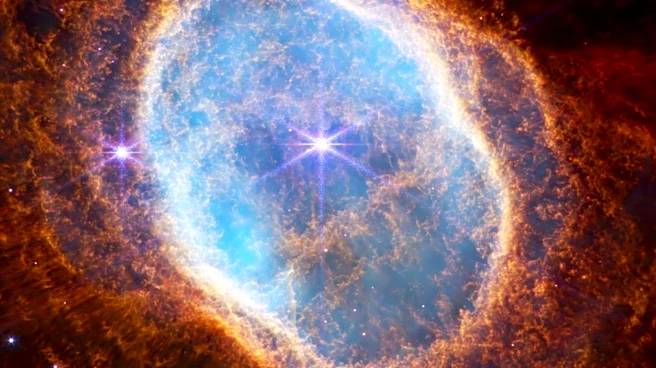
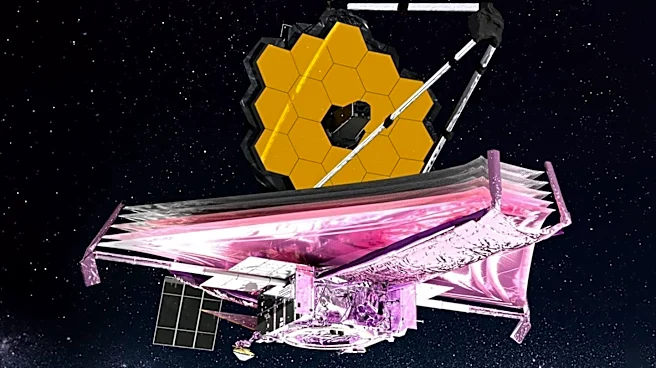
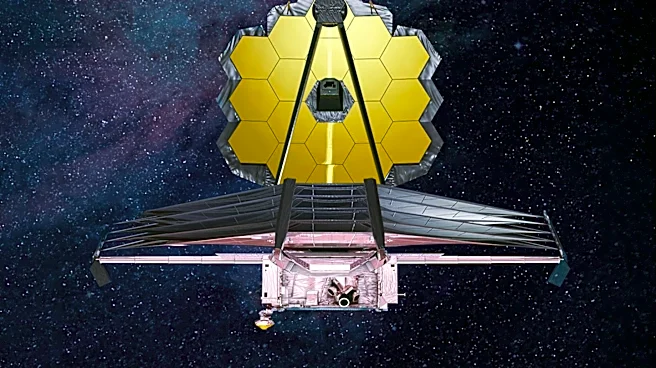
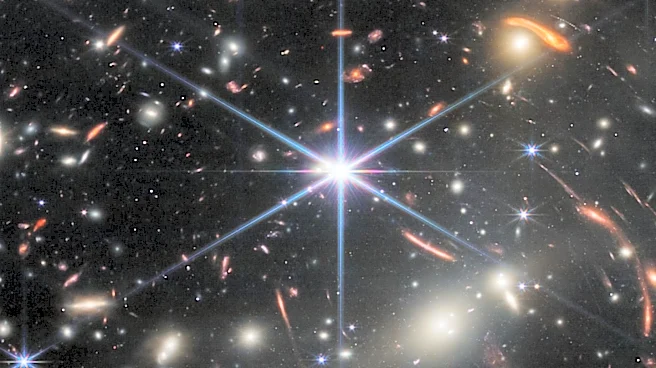
The James Webb Space Telescope (JWST) has provided groundbreaking infrared observations of the early universe, revealing data that challenges existing cosmological models and galaxy formation theories. The JWST has detected surprisingly large and bright
galaxies, such as JADES-GS-z14-0, at extremely distant ranges, dating back to just 300-600 million years after the Big Bang. Standard models predict that galaxies of such mass and luminosity should not have had enough time to form so early in the universe's history. Additionally, new JWST data from 2026 indicates that galaxies began dispersing heavy elements like oxygen, carbon, and silicon into their surroundings as early as 500 million years after the Big Bang. This early enrichment of heavy elements contradicts the expectation that such elements would accumulate slowly over generations of stellar deaths and supernovae. Furthermore, observations led by Cambridge University show that many galaxies from 800 million to 1.5 billion years after the Big Bang exhibit chaotic and irregular structures, rather than the predicted orderly spiral or elliptical forms.
Why It's Important?
These findings are significant because they put pressure on the standard cosmological model, which describes the universe's structure and evolution. The existence of massive, bright galaxies so early in cosmic history suggests that galaxy formation processes were far more efficient or different than previously understood. The early presence of heavy elements implies a more rapid stellar evolution and chemical enrichment than theoretical models account for, potentially limiting the observation of the first generation of pure hydrogen and helium stars (Population III stars). The chaotic galaxy structures also challenge the conventional understanding of how galaxies evolve from small, irregular forms into more organized structures. These discrepancies necessitate a re-evaluation of astrophysical models, particularly those concerning early star formation efficiency and the dynamics of galactic evolution. The data also intensifies debates around fundamental components of the standard model, such as dark matter and dark energy, and the 'Hubble tension' regarding the universe's expansion rate.
What's Next?
The scientific community is now focused on refining astrophysical models rather than discarding the Big Bang theory itself. Researchers are exploring alternative explanations for the observed phenomena, such as the possibility that the extreme brightness of early galaxies is due to rapidly accreting active black holes rather than solely stars, or that these galaxies contain a greater number of faint, low-mass stars than previously estimated. New simulations, including those from the Chinese Academy of Sciences, suggest that gas in the early universe may have cooled and formed stars much faster, or that active black holes could make galaxies appear more massive than they are. Future research will likely involve further high-precision measurements from the JWST and other observatories to test these hypotheses. The ongoing debate about the variability of dark energy and alternative dark matter models will also continue, potentially leading to the discovery of 'new physics' to reconcile the observed discrepancies.
Beyond the Headlines
The implications of the JWST's discoveries extend beyond astrophysics, touching upon the philosophical understanding of the universe's origins and evolution. The need to revise fundamental models highlights the dynamic nature of scientific inquiry, where new observational data can dramatically shift established paradigms. This ongoing scientific discourse underscores the limitations of current theoretical frameworks when confronted with unprecedented empirical evidence. The challenges posed by the JWST data could lead to a more nuanced understanding of cosmic processes, potentially revealing unknown particles or subtle deviations in the laws of gravity that govern the early universe. This era of discovery could redefine our understanding of how matter coalesced, how stars and galaxies formed, and ultimately, how the universe as we know it came to be, pushing the boundaries of human knowledge about our cosmic origins.