


What's Happening?
Astronomers have developed Lumina, the largest simulation of the universe's first 2 billion years, covering a virtual cube approximately 1.5 billion light-years on each side. This simulation tracks matter, dark matter, and radiation, encompassing over 100
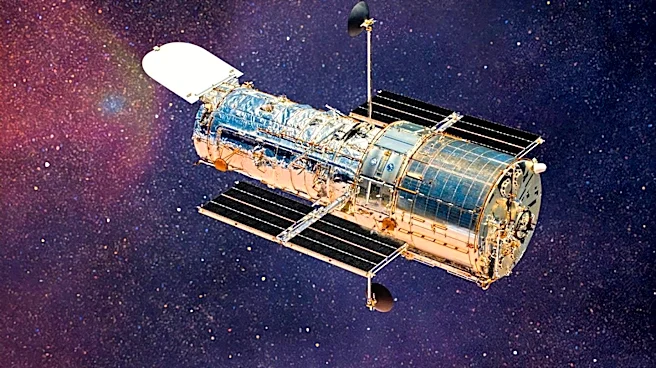
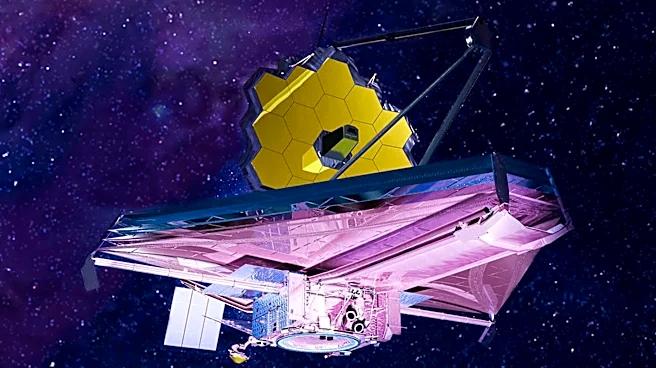
times the volume of previous comparable simulations. Lumina is the first of its kind to model both hydrogen and helium reionization, processes where radiation from early sources stripped electrons from neutral atoms after the Big Bang. The simulation, which ran on the Frontier supercomputer at Oak Ridge National Laboratory in Tennessee, begins 45 million years after the Big Bang and continues for 2 billion years, tracking about half a trillion elements. This extensive scale provides a vast virtual galaxy population, which is crucial for comparing against observations from the James Webb Space Telescope (JWST), particularly regarding the unexpectedly bright early galaxies it has discovered.
Why It's Important?
Lumina's unprecedented scale and detail are vital for addressing a significant puzzle in astrophysics: the surprisingly bright galaxies observed by the James Webb Space Telescope in the early universe. These observations have led some to question whether the standard cosmological model needs revision. By providing a much larger sample of simulated galaxies, Lumina can help determine if these bright galaxies fit within existing theories or if they indicate new physics. The simulation's ability to track both hydrogen and helium reionization offers a detailed, testable model for these critical cosmic events. Understanding the reionization process is fundamental to comprehending how the universe evolved from a dark, neutral state to its current ionized form, impacting the formation and distribution of galaxies and large-scale structures. This research could either validate current cosmological models or necessitate significant adjustments to our understanding of the early universe.
What's Next?
The research team plans to compare Lumina's outputs with data from the James Webb Space Telescope and upcoming sky surveys, including those from NASA's Nancy Grace Roman Space Telescope. This comparison will be crucial for testing whether the rare, very bright galaxies observed by Webb appear naturally within the simulation without requiring new physical laws. Additionally, the team intends to use Lumina to map early large-scale structures and predict gravitational-wave signals from early galaxies and black holes. The simulation's detailed visuals, such as time-lapses of hydrogen reionization bubbles and fly-throughs of massive halos, will also be compared with telescope maps to validate the model's accuracy. The ultimate goal is to determine if Lumina can reconcile the observed brightness of early galaxies with existing theoretical frameworks.
Beyond the Headlines
The development of Lumina represents a significant leap in computational astrophysics, showcasing the power of supercomputing to model complex cosmic phenomena. Beyond its immediate scientific applications, this simulation highlights the ongoing interplay between theoretical models and observational data in advancing our understanding of the universe. The 'bright-galaxy question' itself touches upon the scientific method's core: when observations challenge established theories, it prompts either refinement of the theory or the development of new ones. This process of scientific discovery, driven by both advanced technology and intellectual curiosity, continuously reshapes our cosmic perspective and our place within it. The project also underscores the collaborative nature of modern science, involving multiple institutions and advanced computing facilities.