





What's Happening?
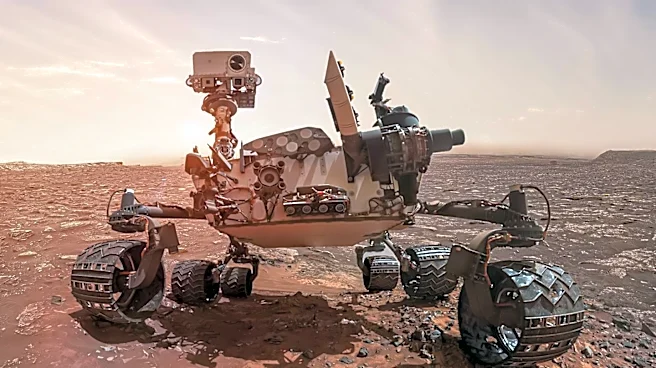
Tiffany M. Morgan has been appointed as the Director of the Mars Exploration Program (MEP) within NASA’s Science Mission Directorate. In this capacity, she is responsible for providing leadership in the exploration and characterization of Mars. Her role
encompasses understanding the planet's current environment, climate, geological history, and biological potential, as well as preparing for future human exploration missions. Morgan joined NASA Headquarters as the MEP Deputy Director in August 2021. Prior to her current role, she served as the Project Manager for the Solar Electric Propulsion (SEP) Project at NASA’s Glenn Research Center. Her career also includes over a decade of experience with Air Force Space Command (now the Space Force), where she focused on rapid space acquisitions, prototyping, and demonstrations. She previously held the position of Chief of the Engineering & Program Integration Division within the Advanced Systems & Development Directorate at Kirtland Air Force Base, where she was instrumental in developing and evolving programmatic and engineering policies for the Directorate’s mission portfolio.
Why It's Important?
The appointment of Tiffany M. Morgan to lead the Mars Exploration Program is significant for the future of U.S. space exploration and scientific research. Her leadership will directly influence the strategic direction and execution of missions aimed at uncovering fundamental questions about Mars, including the potential for past or present life and its habitability for humans. The MEP's work contributes to advancements in planetary science, astrobiology, and engineering, which can have broader implications for technological innovation and scientific understanding. Her extensive background in space acquisitions and program integration from her time with the Air Force Space Command suggests a focus on efficient and effective program management, which is crucial for complex, long-term space endeavors. The success of these missions can inspire future generations in STEM fields and maintain the U.S.'s leadership in space exploration.
What's Next?
Under Tiffany M. Morgan's leadership, the Mars Exploration Program will continue to advance its objectives of exploring and characterizing Mars. This will likely involve overseeing ongoing missions, planning future robotic probes, and developing strategies for eventual human missions to the red planet. Her focus on understanding Mars's environment, climate, and biological potential suggests a continued emphasis on scientific discovery. Given her background in rapid space acquisitions and prototyping, there may be an increased push for innovative and efficient approaches to mission development and execution. The program will also continue its efforts to prepare for human exploration, which involves addressing significant technological and logistical challenges. Future developments will likely include announcements regarding new mission concepts, technological advancements, and international collaborations aimed at achieving these ambitious goals.
Beyond the Headlines
Tiffany M. Morgan's appointment highlights a broader trend within NASA and the U.S. space industry towards integrating diverse expertise, particularly from military and defense sectors, into civilian space programs. Her experience with Air Force Space Command in rapid space acquisitions and prototyping could introduce more agile and streamlined methodologies into NASA's traditionally methodical approach to mission development. This blend of defense-oriented efficiency with scientific exploration could accelerate the pace of discovery and technological advancement in space. Furthermore, her leadership in a program critical to understanding extraterrestrial life and preparing for human colonization of Mars touches upon profound ethical and philosophical questions about humanity's place in the universe and the responsibilities associated with exploring other worlds. The long-term implications of the MEP's work could redefine our understanding of life and push the boundaries of human endeavor.