








What's Happening?
Congresswoman Anna Paulina Luna (FL-13) has presented a federal funding check of $953,390 to Eckerd College. This funding is designated to advance environmental monitoring and marine research, specifically focusing on generating critical data to protect
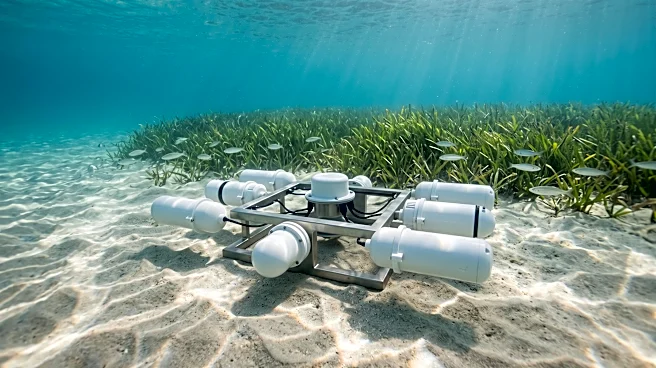
and preserve the coastal resources of Tampa Bay and the West Florida Shelf. The secured funds will support a one-year project within the Eckerd College Marine Science Program, which will monitor major environmental pressures across Tampa Bay. Faculty and students involved in the project will collect vital data on water quality, marine ecosystems, and changing conditions. This information is intended to inform conservation efforts and safeguard coastal resources that are crucial to the region's economy and communities. Rep. Luna emphasized the importance of healthy waters for Florida's way of life, stating that the funding provides scientists and students with the tools to better understand and preserve Tampa Bay for future generations. Eckerd College President James J. Annarelli, Ph.D., highlighted that the four monitoring initiatives supported by this funding will significantly impact ecosystem health and economic vitality in the region.
Why It's Important?
This federal funding is important for several reasons, primarily due to the significant economic and ecological reliance on Tampa Bay's coastal resources. The region's economy, including tourism, commercial fishing, shipping, and recreation, heavily depends on healthy local waters, with an estimated one in ten jobs tied to these resources. Therefore, reliable environmental monitoring is essential not only for protecting marine ecosystems but also for sustaining economic activity. The research conducted by Eckerd College will provide crucial data to guide future conservation efforts and protect the region from issues such as microplastic pollution, red tide blooms, invasive species, and impacts on fisheries. By expanding opportunities for students to contribute directly to research, the funding also strengthens the pipeline of marine science professionals, ensuring continued expertise in environmental stewardship. The long-term health of Tampa Bay directly impacts the livelihoods and well-being of countless Floridians, making this investment a critical step in safeguarding both the environment and the economy.
What's Next?
The Eckerd College Marine Science Program will proceed with its one-year project, utilizing the $953,390 in federal funding to monitor environmental pressures across Tampa Bay. Faculty and students will begin gathering data on water quality, marine ecosystems, and changing conditions. The findings from this research are expected to inform future conservation efforts and guide resource managers in protecting the region's coastal resources. The project will build upon years of existing research by Eckerd faculty on various marine ecosystem changes, including harmful algal blooms, emerging contaminants, wildlife, biodiversity, and economically important fisheries. The college anticipates that this funding will expand opportunities for students to engage in hands-on research, potentially leading to more students earning prestigious scholarships and fellowships. The data collected will be crucial for understanding and addressing environmental challenges in Tampa Bay and the West Florida Shelf, influencing policy decisions and conservation strategies in the coming years.
Beyond the Headlines
Beyond the immediate environmental and economic benefits, this funding underscores a broader commitment to scientific research and education as foundational elements for regional resilience. The emphasis on hands-on research for undergraduate students at Eckerd College highlights the importance of experiential learning in developing future scientists and environmental stewards. This approach not only contributes to specific research outcomes but also cultivates a generation equipped to tackle complex environmental challenges. The project's focus on understanding changing conditions in marine ecosystems reflects a proactive stance against the long-term impacts of climate change and human activity on coastal environments. Furthermore, the collaboration between a federal representative and a local academic institution exemplifies how targeted funding can bridge policy needs with scientific expertise, fostering a more informed and effective approach to environmental management. This initiative could serve as a model for other coastal regions facing similar ecological and economic pressures, demonstrating the value of investing in local research capabilities.