
What's Happening?
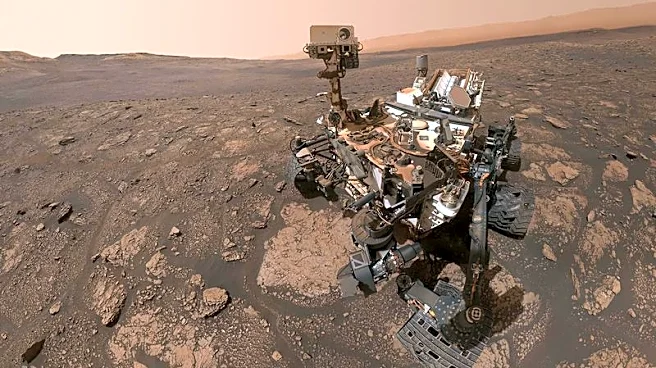
NASA's Curiosity rover has discovered more than 20 organic molecules in ancient rocks on Mars, dating back 3.5 billion years. This discovery was made in the Gale Crater using a novel heat-and-reagent technique,
marking the first time such a method has been used on another planet. The molecules include aromatics and sulfur- and nitrogen-bearing compounds, which are known to persist over long periods. While the findings do not confirm the presence of life, they provide new data for scientists to explore the potential for habitability on Mars. The discovery suggests that organic matter can survive on Mars despite harsh conditions, and it strengthens the belief that Curiosity sampled genuine Martian material rather than contamination from the rover itself.
Why It's Important?
The discovery of these organic molecules is significant as it enhances our understanding of Mars' chemical history and its potential to support life. The presence of complex organic compounds suggests that Mars may have been more hospitable to life in the past than previously thought. This finding could influence future Mars missions and the search for life beyond Earth. It also demonstrates the effectiveness of new scientific techniques in space exploration, potentially paving the way for more advanced studies on Mars and other celestial bodies. The implications extend to understanding the preservation of life's building blocks in extreme environments, which could inform astrobiology and the search for extraterrestrial life.
What's Next?
Curiosity will continue to conduct experiments as it ascends Mount Sharp, focusing on different geological layers to understand the planet's transition from wet to dry conditions. These ongoing studies aim to provide further insights into Mars' past environments and their capacity to support life. The results will guide future missions, including NASA's Dragonfly mission to Titan, which will explore organic chemistry under different conditions. The findings from Curiosity's experiments will serve as a benchmark for these missions, potentially leading to new discoveries about the origins and preservation of life in the solar system.