







What's Happening?
The Expedition 74 crew aboard the International Space Station (ISS) has initiated a series of scientific experiments aimed at advancing health and sustainability in space. The crew, including NASA astronauts and international partners, is focusing on bioprinting
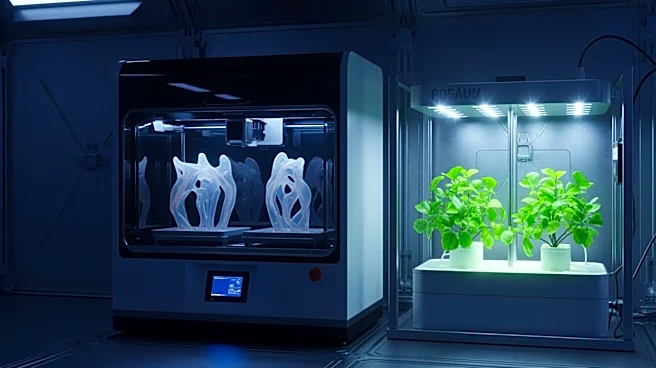
human cartilage tissue and harvesting alfalfa plants. These activities are part of broader efforts to develop self-sustaining space missions. NASA flight engineer Jessica Meir and her colleague Chris Williams are leading the cartilage bioprinting project, which involves creating viable cartilage tissues in microgravity. This research could lead to on-demand implants using a patient's own cells, potentially revolutionizing medical treatments in space. Concurrently, astronauts Jack Hathaway and Chris Williams are working on the Veg-06 study, which involves growing alfalfa plants in the Columbus laboratory module. The harvested plants are being analyzed to improve food production methods for future space missions. Additionally, the crew is conducting ultrasound vein scans to study the effects of space on human biology and retrieving materials exposed to the space environment for testing.
Why It's Important?
These experiments are crucial for the future of long-duration space missions, as they address key challenges in health and sustainability. The ability to bioprint human tissues in space could significantly enhance medical care for astronauts, reducing the need for Earth-based medical interventions. This capability is particularly important for missions to Mars or other distant destinations where immediate medical support is unavailable. The plant growth experiments are equally vital, as they aim to develop reliable food sources for astronauts, reducing dependency on Earth-supplied provisions. Understanding how plants grow in microgravity can lead to innovative agricultural techniques that could also benefit Earth-based farming. The research on space-induced physiological changes, such as blood clot risks, is essential for ensuring astronaut safety and health. Overall, these advancements could pave the way for more sustainable and self-sufficient space exploration, with potential applications in various industries on Earth.
What's Next?
The ongoing research aboard the ISS will continue to yield insights into the challenges of living and working in space. Future steps may include refining bioprinting techniques to enhance tissue stability and exploring additional plant species for space agriculture. The data collected from these experiments will inform the design of future space missions, particularly those involving extended stays on the Moon or Mars. Collaboration with international space agencies and private companies could accelerate the development of technologies that support human life in space. As the ISS continues to serve as a platform for scientific discovery, the findings from these studies will contribute to the broader goal of establishing a sustainable human presence beyond Earth.