
What's Happening?
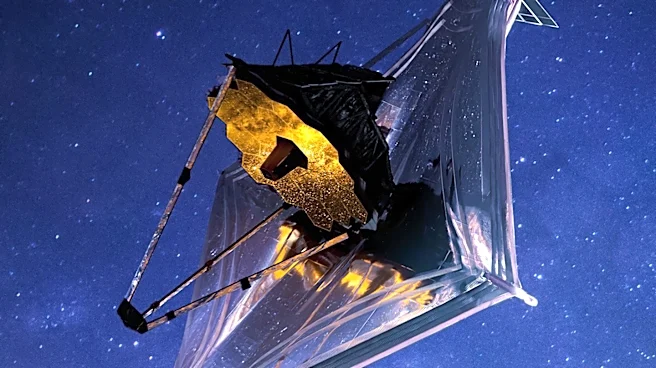
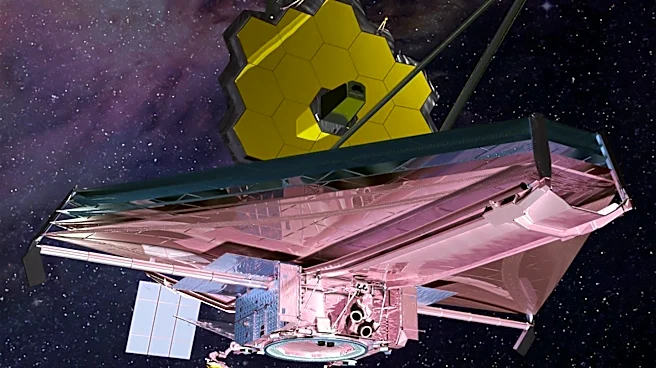
The James Webb Space Telescope (JWST) has made a significant discovery regarding the early universe, revealing that the first galaxies were much larger and more massive than previously estimated. By studying
nine early galaxies that have completed their intense star formation periods, astronomers found a much greater proportion of small, faint stars compared to modern galaxies like the Milky Way. This finding challenges previous assumptions that the proportion of stars of different masses remained constant throughout cosmic history. The JWST's sensitivity allowed researchers to detect these previously 'hidden stars,' which were overshadowed by more massive, brighter stars in earlier observations. This means that the total mass of these early galaxies is considerably higher than what was calculated based on their overall light spectrum, which is typically dominated by the most massive stars.
Why It's Important?
This discovery by the James Webb Space Telescope has profound implications for our understanding of galaxy formation and evolution in the early universe. If early galaxies contained significantly more mass in smaller stars, it necessitates a revision of current models of galaxy formation. This could alter our understanding of how structures in the universe developed and grew over cosmic time. Furthermore, the finding suggests that the early universe might have formed more planets than previously assumed, as many planets orbit smaller stars. This could impact theories on the prevalence of planetary systems and potentially life beyond Earth. The ability of the JWST to detect these faint stars highlights the telescope's advanced capabilities and its role in pushing the boundaries of astronomical research, providing unprecedented insights into the universe's origins.
What's Next?
The immediate next step for astronomers will be to integrate these new findings into existing models of galaxy formation and evolution. Further observations with the James Webb Space Telescope will likely focus on additional early galaxies to confirm if this higher proportion of small stars is a widespread characteristic or specific to the studied sample. Researchers will also need to refine their analytical techniques to account for the newly discovered stellar populations. The implications for planet formation will spur new theoretical work and potentially guide future observational campaigns aimed at detecting exoplanets in very distant, early galaxies. This ongoing research will continue to leverage the JWST's unique capabilities to unravel the mysteries of the universe's infancy and refine our cosmic understanding.
Beyond the Headlines
The revelation of 'hidden stars' in early galaxies touches upon a fundamental aspect of scientific discovery: the continuous refinement of our understanding as new tools and data become available. It underscores that our current models of the universe are always subject to revision based on empirical evidence. This particular finding challenges a long-held assumption about stellar mass distribution, demonstrating how even seemingly minor details can have cascading effects on broader cosmological theories. Ethically, it reinforces the value of investing in advanced scientific instruments like the JWST, which provide the means to observe phenomena previously beyond our reach. Culturally, it expands our cosmic narrative, painting a more complex and potentially richer picture of the universe's beginnings and the conditions under which stars and planets first formed.