




What's Happening?
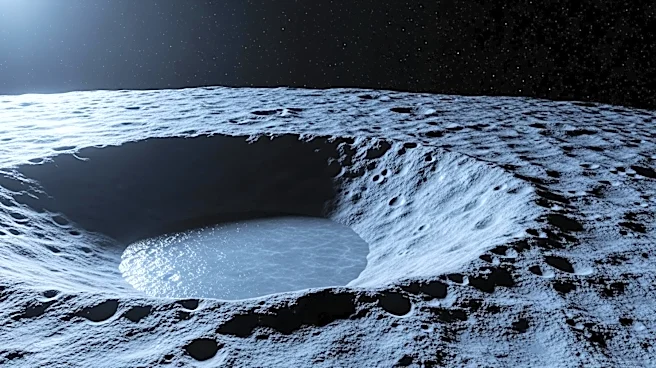
New research proposes that Mercury's water ice may have been deposited by a single, slow asteroid impact within one Mercurian day. The study suggests that a massive impact, similar to the one that formed the Hokusai crater, could have rapidly spread water across
the planet and trapped it in permanently shadowed polar craters. This finding challenges previous theories that water ice was gradually supplied over time, offering new insights into the planet's geological history and the dynamics of water distribution in the solar system.
Why It's Important?
Understanding the origin of Mercury's water ice is crucial for planetary science and our knowledge of the solar system's evolution. The study's findings could reshape theories about how water is distributed on rocky planets, influencing future research on planetary formation and habitability. The presence of water ice on Mercury, despite its proximity to the sun, raises questions about the potential for similar processes on other celestial bodies. This research also highlights the importance of continued exploration and observation to uncover the mysteries of our solar system.
What's Next?
The upcoming BepiColombo mission, a joint European-Japanese effort, is expected to provide further insights into Mercury's polar ice. Scheduled to enter orbit around Mercury, the mission will conduct detailed studies of the planet's surface and composition. These observations could confirm the study's findings and offer new data on the planet's geological and atmospheric processes. The mission's success could pave the way for future explorations and enhance our understanding of water distribution in the solar system.