





What's Happening?
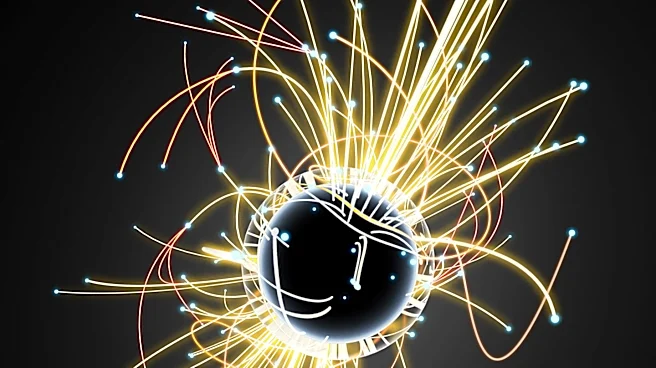
The CMS experiment at CERN is actively pursuing a novel method for detecting dark matter by searching for two low-momentum electrons that appear at a distance from proton-proton collisions. This approach targets a specific signature: the presence of these
electrons accompanied by missing transverse momentum, which indicates that invisible particles are carrying away energy. This phenomenon is predicted by theories of inelastic dark matter, where a dark matter particle interacts with a partner state before decaying. Researchers are utilizing a specialized reconstruction method, originally developed for B hadron decays, to identify these faint electron signals. This method allows for the detection of electrons with transverse momenta as low as 1 GeV, significantly lower than the 5 GeV threshold of standard techniques, thereby recovering events that would otherwise be missed in conventional dark matter searches. Bryan Cardwell, a postdoc at the University of Virginia, emphasizes that this method makes the search for inelastic dark matter at the Large Hadron Collider (LHC) particularly exciting, as it offers a chance to observe something that might otherwise be invisible. While initial data analysis has not revealed any significant excess of events beyond those predicted by known physics, the CMS collaboration has established the first collider limits on inelastic dark matter in the electron channel, constraining theoretical models with small mass differences and measurable displacements.
Why It's Important?
The search for dark matter is a fundamental endeavor in particle physics and cosmology, aiming to understand the composition of approximately 27% of the universe that remains unseen and unexplained by the Standard Model of particle physics. The CMS experiment's novel approach to detecting inelastic dark matter through displaced electron pairs is significant because it explores a region of dark matter parameter space that is largely inaccessible to other experiments. By setting the first collider limits on inelastic dark matter in the electron channel, the CMS collaboration is narrowing down the range of possible dark matter candidates and refining theoretical models. This research could lead to a breakthrough in understanding the nature of dark matter, which has profound implications for our understanding of galaxy formation, the large-scale structure of the universe, and the fundamental laws of physics. The ability to detect low-momentum electrons originating far from the collision point, a challenging task, demonstrates the power of repurposing established techniques for new physics searches and expands the capabilities of particle accelerators like the LHC in probing beyond the Standard Model.
What's Next?
With the anticipated larger dataset from Run 3 of the LHC, future analyses by the CMS collaboration are expected to probe even lower dark matter masses and greater displacement scenarios. This expansion will occur in both the electron and muon channels, further extending the boundaries of dark matter exploration. The team anticipates that these expanded searches will continue to refine the constraints on inelastic dark matter models, potentially revealing the elusive nature of this mysterious substance. The ongoing work represents a novel approach to a long-standing problem in particle physics, leveraging the unique capabilities of the CMS detector and advanced reconstruction techniques. Researchers will continue to analyze data, apply machine-learning techniques to distinguish potential signal events from background noise, and publish their findings, contributing to the global effort to unravel the mysteries of the dark universe. The establishment of new limits and the exploration of previously inaccessible regions of dark matter parameter space will guide future theoretical developments and experimental designs.
Beyond the Headlines
The pursuit of dark matter detection, as exemplified by the CMS experiment, transcends immediate scientific findings by pushing the boundaries of human knowledge and technological innovation. The development and application of specialized reconstruction techniques, such as those originally designed for B hadron decays, highlight the interdisciplinary nature of scientific research and the unexpected utility of tools developed for one purpose in solving another. This research also underscores the philosophical implications of our universe's composition; if a significant portion of the universe is indeed made of dark matter that interacts only weakly with ordinary matter, it challenges our fundamental understanding of reality and the forces that govern it. The continuous refinement of experimental methods and theoretical models in the search for dark matter reflects a broader scientific commitment to exploring the unknown, fostering international collaboration, and inspiring future generations of scientists to tackle complex problems. The potential discovery of dark matter would not only revolutionize physics but also reshape our cosmic perspective.