








What's Happening?
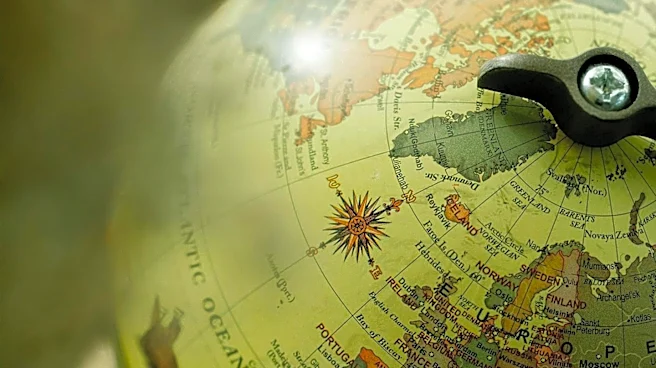
Recent research by experts in African map history is challenging the long-held misconception that European maps of Africa were based solely on European observations. This new understanding reveals that much of the geographical information on colonial-era
maps of West Africa originated from African observations and mapping practices, with Europeans often taking the credit. For instance, sections of French explorer Henri Duveyrier’s 1861 map of the Sahara were significantly informed by maps drawn in the sand by his guide, Cheikh-’Othmàn, with over a third of the map's information coming from local sources. Similarly, French Navy Lt. Louis-Gustave Binger's 1892 travel memoir includes a plan of Niellé, a city in contemporary northern Ivory Coast, drawn by his interpreter, Fofana Diawé. Another example is Navy Lt. Jean-Baptiste Marchand, who routinely collected route information from local inhabitants for his maps of the region between the Niger River and the Gulf of Guinea in the early 1890s, with African sources accounting for 65% of the routes on his map. These locally sourced routes were often depicted with dashed lines, while European-surveyed routes were solid.
Why It's Important?
This re-evaluation of African mapmaking history is crucial for several reasons. It debunks the myth of European cartographic exclusivity and highlights the significant, often unacknowledged, contributions of African individuals and communities to geographical knowledge. This shift in perspective challenges the colonial narrative that often minimized or erased indigenous intellectual achievements. By recognizing African mapping practices, it promotes a more accurate and inclusive understanding of history, emphasizing the complex intercultural encounters that shaped the continent's cartography. This research also sheds light on how European colonial powers utilized African knowledge for their own expansionist goals, as maps that Africans helped construct were later used to divide their territories. Understanding this historical dynamic is vital for decolonizing knowledge and fostering a more equitable appreciation of global intellectual heritage, impacting how history is taught and understood in the U.S. and globally.
What's Next?
The ongoing research into African map history suggests a continued effort to uncover and acknowledge the contributions of indigenous populations to cartography. As map historians delve into national archives, they are finding more evidence of these 'hybrid productions'—maps that are a result of complex intercultural exchanges rather than purely European achievements. This trend indicates that future historical accounts and educational materials will likely incorporate these findings, leading to a more nuanced and accurate portrayal of Africa's past. The discussion around 'blank spaces' on maps, often seen as areas open to colonization, is also being reinterpreted as a result of African authorities' refusal to grant access to European explorers. This recontextualization will continue to challenge prevailing narratives and encourage a deeper examination of the power dynamics inherent in historical mapmaking and exploration.
Beyond the Headlines
The debate among European geographers and military officers regarding the inclusion of locally sourced information on maps reveals a deeper ideological conflict. Some argued against it, citing a lack of 'scientific cartography' standards, while others, particularly military officers, valued its practical utility for imperial expansion. This debate was embedded in the 'civilizing mission' ideology of colonialism, which asserted the superiority of European knowledge. The use of dashed lines for African-sourced information versus solid lines for European measurements visually reinforced this hierarchy, suggesting that indigenous knowledge was tentative and inferior. This subtle yet powerful form of epistemic injustice had long-lasting effects on how African knowledge was perceived and valued. Recognizing this historical bias is essential for contemporary efforts to decolonize academic disciplines and promote intellectual equity, highlighting the ethical dimensions of knowledge production and dissemination.