





What's Happening?
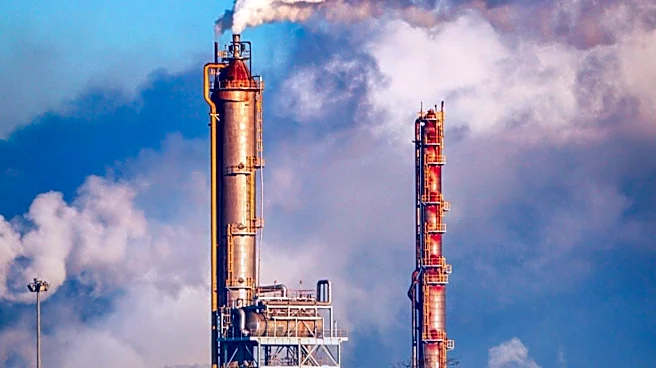
Ethanol plants across the U.S., predominantly in the Midwest, are releasing significant amounts of air pollution, leading to substantial public health costs and premature deaths. A federal loophole, established by a 2007 EPA rule, allows these plants to emit
up to 250 tons of certain pollutants annually before triggering a full federal permit review, which is 2.5 times higher than the threshold for other chemical plants. This rule reclassified ethanol plants using natural fermentation, removing them from the 'chemical process plant' category and excluding fugitive emissions from the threshold count. The Environmental Integrity Project reported in 2024 that ethanol plants released 1.3 million pounds of acetaldehyde in 2023, a probable human carcinogen. The EPA's COBRA model estimates that current emission levels from 167 ethanol plants lead to 71 to 125 premature deaths and $1.1 billion to $1.9 billion in public health costs annually. Despite these findings, Congress has moved to expand year-round E15 ethanol sales, potentially exacerbating the issue.
Why It's Important?
This situation highlights a critical public health and environmental justice issue. The elevated pollution thresholds for ethanol plants disproportionately affect communities, often far from the plants themselves, as pollutants like nitrogen oxides and volatile organic compounds drift and transform into dangerous fine particles and ozone. Cook County, Illinois, for example, which has no ethanol plants, bears more health costs than any other county. The expansion of E15 sales without addressing these pollution concerns could lead to increased emissions and associated health burdens, including asthma attacks, heart attacks, strokes, and premature deaths. This also raises questions about regulatory fairness, as other chemical plants operate under stricter emission limits. The economic impact is significant, with billions of dollars in public health costs being externalized onto society rather than being fully accounted for by the industry.
What's Next?
States have the authority to implement stricter air pollution regulations than federal law, offering a potential path forward. Minnesota and Illinois, which host a significant number of ethanol plants and incur substantial health costs, could set their own 100-ton emission threshold for ethanol plants, aligning them with other chemical facilities. States can also mandate health screenings for new ethanol plants or expansions. The EPA could reopen the public comment period it promised in 2019 regarding the rule's provisions for areas failing air standards. Furthermore, the EPA could reverse its 2019 denial and reclassify ethanol plants as chemical process plants, as argued by the Natural Resources Defense Council. Congressional actions regarding E15 sales will also influence the market for ethanol and, consequently, the potential for increased emissions.
Beyond the Headlines
The disparity in regulatory standards for ethanol plants compared to other chemical facilities points to a broader issue of how environmental regulations are shaped by industry-specific considerations and lobbying efforts. The classification of ethanol plants under the Clean Air Act has allowed them to operate with less stringent oversight, potentially undermining the act's intent to protect public health. This situation also underscores the challenge of addressing diffuse pollution impacts, where the sources of pollution are geographically distant from the populations experiencing the health consequences. The ongoing debate over biofuel mandates and their environmental footprint highlights the complex interplay between energy policy, agricultural interests, and public health, often leading to trade-offs that may not fully account for externalized costs.