



What's Happening?
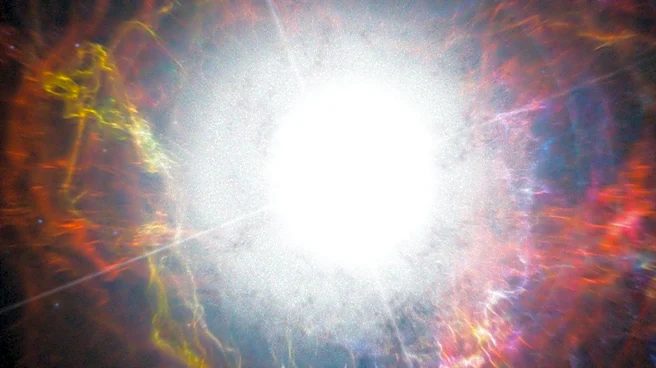
Astronomers are anticipating a 'cataclysmic' nova explosion from the binary star system T Coronae Borealis (T CrB), also known as the 'Blaze Star.' This system consists of a white dwarf star and a red giant. Approximately every 80 years, the white dwarf strips
material from the red giant until a critical mass is reached, triggering a nova explosion. This event will cause a flare of light approximately 1,000 times its usual brightness, making it visible even with basic telescopes. The last eruption occurred in 1946, making another event imminent. Elizabeth Hays, lab chief at Astroparticle Physics Laboratory, expressed surprise if the explosion doesn't occur before 2030. While an exact date cannot be provided, scientists are confident it will happen soon, with amateur astronomers continuously monitoring the star system.
Why It's Important?
The impending nova explosion of T Coronae Borealis offers a rare and significant opportunity for both professional and amateur astronomers to observe a celestial event of immense scale. Such events provide valuable data for understanding stellar evolution, binary star systems, and the physics of nova explosions. The increased brightness will make it accessible to a wider audience, potentially sparking public interest in astronomy and science. For researchers, observing the lead-up and aftermath of this explosion can refine models of white dwarf accretion and thermonuclear runaway processes. The event's predictability, within a general timeframe, allows for coordinated observational campaigns, maximizing the scientific return and contributing to a deeper understanding of the universe's dynamic processes.
What's Next?
The immediate next step involves continuous monitoring of T Coronae Borealis by astronomers, particularly amateur astronomers who are already providing 'hair-trigger monitoring.' Once the star brightens by approximately one magnitude, alerts will be disseminated globally within minutes, signaling the start of the nova event. The explosion is expected to last for a period before the star system returns to its normal cycle, meaning observers would have to wait until the 2100s for another such event. Scientists like Bradley Schaefer of the Louisiana State University Department of Physics and Astronomy emphasize that the exact timing depends on the rate of gas accumulation on the white dwarf's surface and the specific trigger mass required for the hydrogen bomb-like eruption.
Beyond the Headlines
Beyond the immediate scientific observation, the T Coronae Borealis nova explosion highlights the ongoing advancements in astronomical technology, such as the James Webb Space Telescope, which allows for unprecedented views of the cosmos. However, the fact that even basic telescopes are expected to pick up this event underscores the accessibility of astronomy and its potential to engage the public. This event also serves as a reminder of the dynamic and often violent processes occurring in the universe, challenging our perceptions of celestial stability. The collaborative effort between professional and amateur astronomers in monitoring such events exemplifies the community-driven nature of scientific discovery and the shared human curiosity about the cosmos.