
What's Happening?
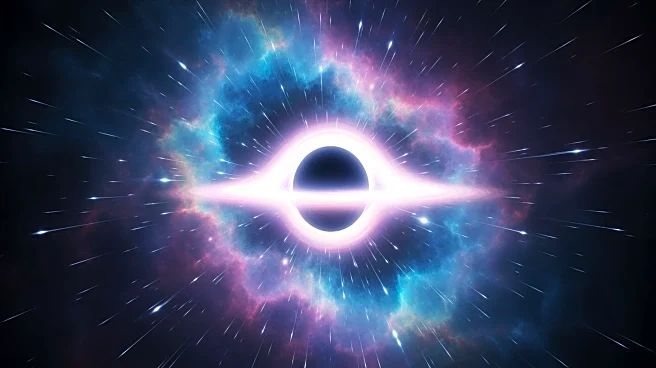
Physicists at the University of Massachusetts Amherst have proposed that a high-energy neutrino detected in 2023 could be explained by the explosion of a quasi-extremal primordial black hole. This type
of black hole, theorized by Stephen Hawking, could emit particles through Hawking radiation as it evaporates. The team suggests that such explosions could occur with surprising frequency, potentially providing a catalog of subatomic particles, including those hypothesized like dark matter particles. The detection of this neutrino, which was 100,000 times more energetic than any produced by the Large Hadron Collider, supports their hypothesis. However, a similar experiment, IceCube, did not register the event, raising questions about the consistency of these findings.
Why It's Important?
This hypothesis, if proven, could significantly advance our understanding of the universe's fundamental nature. It offers a potential explanation for the existence of dark matter and could provide evidence for Hawking radiation, a key aspect of black hole physics. The ability to detect and analyze such high-energy neutrinos could lead to breakthroughs in particle physics and cosmology, potentially revealing new particles beyond the Standard Model. This research underscores the importance of continued investment in cosmic observation technologies and theoretical physics to explore these phenomena.
What's Next?
The next steps involve further observations and experiments to detect more high-energy neutrinos and confirm the existence of quasi-extremal primordial black holes. If these findings are consistent, they could lead to a deeper understanding of dark matter and the universe's early conditions. The scientific community will likely focus on refining detection methods and exploring the implications of these potential discoveries on existing theories of physics.