







What's Happening?
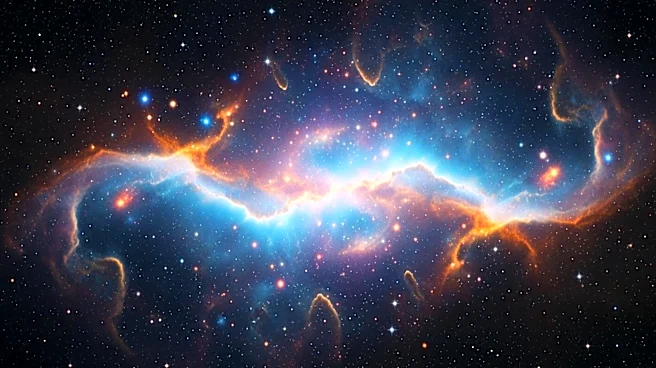
NASA is marking the 36th anniversary of the Hubble Space Telescope's launch by releasing a new image of the Trifid Nebula, also known as the 'Cosmic Sea Slug.' The Hubble Telescope, which was launched on April 24, 1990, has made nearly 1.7 million observations
and targeted about 55,000 astronomical objects. These observations have contributed to over 22,000 scientific papers and more than 1.3 million citations, establishing Hubble as one of the most influential scientific instruments. The new image revisits the Trifid Nebula, a star-forming region approximately 5,000 light-years away, showcasing a structure that includes a jet from Herbig-Haro 399, illustrating how young stars shape their surroundings.
Why It's Important?
The Hubble Space Telescope has been pivotal in advancing our understanding of the universe. Its observations have led to significant discoveries, including insights into the expansion of the universe and the nature of black holes. The telescope's ability to capture detailed images of distant galaxies and nebulae has provided invaluable data for astronomers and researchers worldwide. As Hubble continues to operate, it remains a crucial tool for scientific exploration, inspiring future generations of scientists and contributing to the broader field of astrophysics.
What's Next?
Hubble's successor, the Nancy Grace Roman Space Telescope, is expected to launch as early as September 2026. This new telescope will have the capability to capture a field of view 100 times larger than Hubble's, promising to expand our understanding of the universe even further. The continued operation of Hubble alongside the upcoming launch of the Roman Space Telescope will ensure that NASA remains at the forefront of astronomical research and discovery.