
What's Happening?
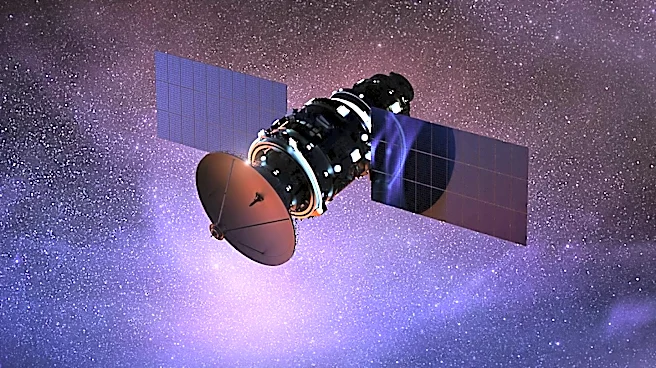
Astronomers, utilizing NASA’s Chandra X-ray Observatory, have identified the cause behind the recurring bright outbursts of the massive star AT 2016blu, located in the galaxy NGC 4559. For approximately
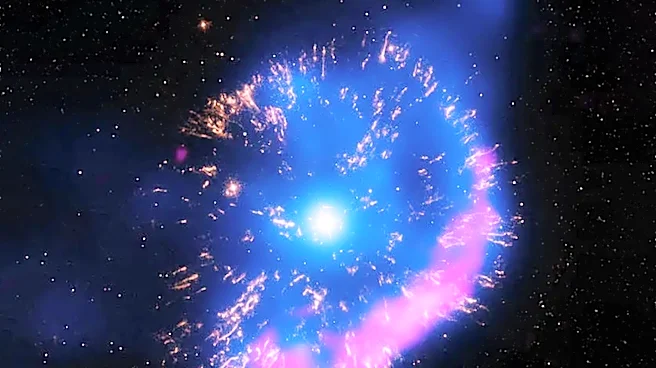
15 years, this star has been mimicking supernova explosions, leading scientists to initially mistake its eruptions for actual supernovae. However, AT 2016blu consistently survived these events, earning it the label of a 'supernova imposter.' The recent discovery confirms that a hidden compact object, likely a stellar-mass black hole or a neutron star, is gravitationally pulling material from AT 2016blu. This compact companion orbits the star in an elliptical path with a period of 113 days. During its closest approach, the companion's gravity strips matter from the luminous blue variable star, forming a hot accretion disk around the compact object. This disk then emits powerful X-rays, which heat a previously ejected dense cloud of gas from AT 2016blu, causing it to shine brightly in visible light and create the illusion of a supernova. At least 27 such outbursts have been recorded since 2012.
Why It's Important?
This discovery is significant for understanding the complex dynamics within distant star systems and the life cycles of massive stars. The identification of a compact companion as the driver of these periodic outbursts provides crucial insights into phenomena that were previously poorly understood. It helps differentiate between true supernovae, which result in the star's destruction, and 'supernova imposters,' which are recurring events. This research may also establish a link between supernova imposters and ultraluminous X-ray sources, a class of cosmic objects that are not yet fully understood but are typically associated with compact objects. By clarifying the mechanisms behind these energetic events, astronomers can refine models of stellar evolution, particularly for massive stars that exhibit similar brightness variations, and better predict the conditions leading to actual supernova explosions. The study underscores the critical role of advanced X-ray observatories like Chandra in unraveling cosmic mysteries.
What's Next?
Further observations and detailed analysis of AT 2016blu and similar systems will likely focus on refining the characteristics of the compact companion, such as its precise mass and orbital parameters. Researchers will aim to gather more X-ray data during future outbursts to better understand the accretion process and the energy transfer mechanisms that lead to the visible light flares. This could involve coordinating observations with other telescopes across different wavelengths to build a more comprehensive picture of the system. The findings may also prompt astronomers to re-examine other known supernova imposters to determine if similar compact companions are responsible for their behavior. Additionally, this research could inform the search for and characterization of other ultraluminous X-ray sources, potentially leading to a broader understanding of their nature and their connection to binary star systems involving black holes or neutron stars.
Beyond the Headlines
The unraveling of AT 2016blu's mystery highlights the ongoing evolution of our understanding of the universe, where phenomena that once seemed straightforward (like a supernova) can turn out to be far more complex. This discovery challenges previous assumptions about stellar explosions and emphasizes the dynamic and often deceptive nature of cosmic events. It also underscores the power of long-term observational campaigns and the integration of data from various instruments, like the Chandra X-ray Observatory, to piece together intricate astrophysical puzzles. The existence of 'supernova imposters' driven by hidden companions suggests that the universe may harbor many more such binary systems, influencing our understanding of stellar populations, galaxy evolution, and the distribution of compact objects. This continuous refinement of cosmic narratives reflects the scientific process itself, where new data constantly reshapes our perception of reality beyond Earth.