



What's Happening?
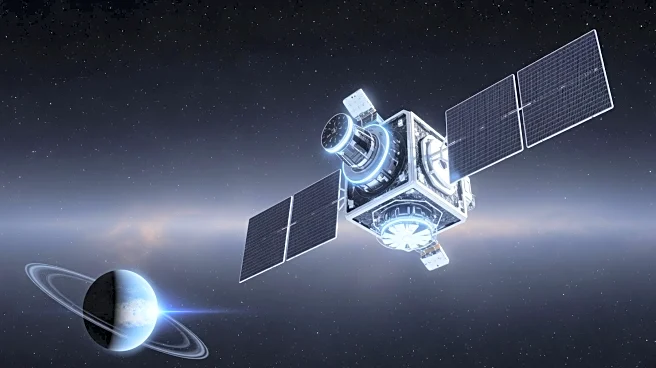
NASA's Pandora small satellite was successfully launched aboard a SpaceX Falcon 9 rocket from Vandenberg Space Force Base in California. The mission, part of NASA's Astrophysics Pioneers program, aims to study the atmospheres of at least 20 exoplanets
and the activity of their host stars. Pandora will operate in a sun-synchronous orbit, allowing it to pass over the same spot on Earth at the same time each day, minimizing light variations. The satellite will use its telescope to collect visible and infrared light, helping scientists differentiate between planetary and stellar signals. This mission is a collaboration between NASA's Goddard Space Flight Center, Lawrence Livermore National Laboratory, and other institutions.
Why It's Important?
The Pandora mission is significant as it enhances our understanding of exoplanetary atmospheres, potentially identifying elements and molecules like water and oxygen, which are crucial for life. By distinguishing between signals from planets and their stars, Pandora will improve the accuracy of exoplanet studies. This mission also supports NASA's broader efforts in space exploration and scientific research, providing valuable data that could inform future missions and the search for habitable planets. The collaboration among various institutions highlights the importance of partnerships in advancing space science.
What's Next?
Following its successful deployment, Pandora will begin its year-long mission to observe exoplanets and their host stars. The data collected will be analyzed to determine the presence of atmospheric components. Additionally, the mission will contribute to the development of future space telescopes and observational techniques. The success of Pandora could lead to more missions under NASA's Astrophysics Pioneers program, furthering our understanding of the universe.