








What's Happening?
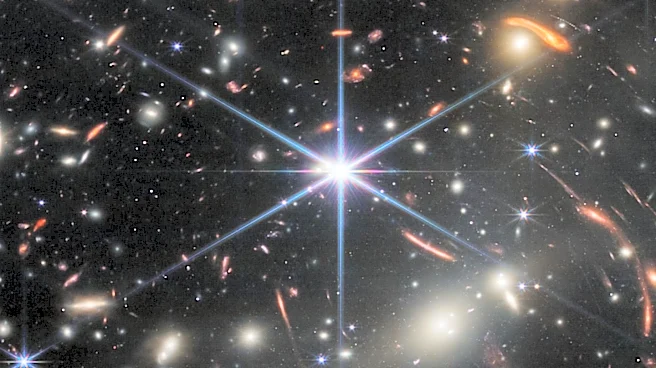
The James Webb Space Telescope (JWST) has captured a new image revealing an expansive cosmic cloud within the star-forming region IC 348, located approximately 1,000 light-years away. This image showcases glowing wisps of translucent gas and dust, where
cold molecular hydrogen gas collapses to form new stars. The cosmic landscape is dotted with numerous twinkling stars. This observation is part of a scientific program aimed at identifying and studying brown dwarfs, which are celestial objects that form like stars but lack sufficient mass to initiate hydrogen fusion in their cores. Brown dwarfs are less massive than the smallest stars but more massive than the largest planets, making them a subject of ongoing scientific inquiry.
Why It's Important?
This new image and the ongoing research are significant for advancing our understanding of star formation and the mysterious nature of brown dwarfs. Brown dwarfs represent a critical gap in our knowledge of celestial objects, bridging the divide between planets and stars. Their study helps scientists comprehend the conditions under which stars and planetary systems form, and how these objects vary across the universe. Although brown dwarfs are dim in visible light, their emission of infrared radiation makes them detectable by instruments like those on the JWST. The ability to find and characterize these objects, especially smaller ones, provides crucial data for refining astrophysical models and theories about cosmic evolution. This research contributes to a more complete picture of the universe's composition and the processes that govern it.
What's Next?
The current observing program utilizing the JWST aims to continue the search for even smaller brown dwarfs within regions like IC 348. Researchers previously identified brown dwarfs in this region that were only a few times more massive than Jupiter in 2022. The goal is to discover brown dwarfs at the lower end of the mass spectrum to gain deeper insights into their formation mechanisms and characteristics. Future observations and data analysis will focus on refining these detections and understanding the prevalence and properties of these enigmatic objects. This ongoing research will contribute to a more comprehensive understanding of stellar and substellar evolution, potentially leading to new discoveries about the universe's fundamental building blocks.
Beyond the Headlines
The JWST's capabilities in capturing detailed infrared images allow scientists to peer through cosmic dust, revealing phenomena that are otherwise obscured. This technological advancement not only facilitates the discovery of new celestial bodies but also enhances our ability to study the early stages of star and planet formation. The quest to understand brown dwarfs touches upon fundamental questions about the universe's mass distribution and the conditions necessary for different types of celestial objects to emerge. The findings from this research could influence theories on exoplanet formation and the potential for life beyond Earth, as brown dwarfs can host their own planetary systems. This ongoing exploration pushes the boundaries of human knowledge, inspiring future generations of scientists and space enthusiasts.