
What's Happening?
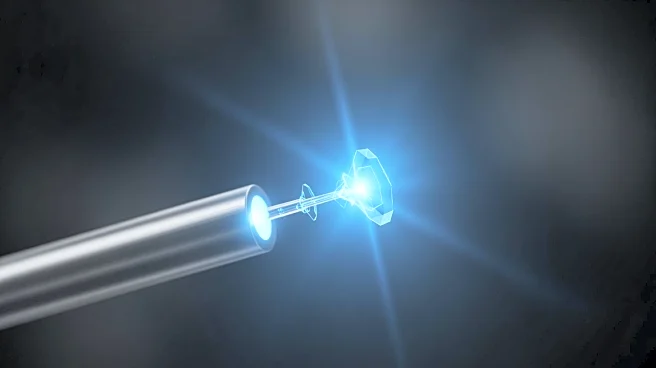
Researchers at Fudan University have successfully imaged the Wigner crystal state in a new type of quantum material, specifically a monolayer of ytterbium chloride (YbCl₃) on graphite. This achievement
was made possible through the use of q-Plus atomic force microscopy (AFM), which allowed for sub-unit-cell resolution images. The study, published in Physical Review Letters, reveals that electrons transferred from the graphite substrate to the YbCl₃ monolayer form a 'heavy' Wigner crystal. This state is characterized by a high electron density and significant mutual Coulomb repulsion, leading to a crystal-like arrangement of electrons.
Why It's Important?
The ability to image the Wigner crystal state in such detail opens new avenues for research into strongly correlated electron systems. This discovery could have significant implications for the development of quantum materials and technologies. Understanding the behavior of electrons in these states is crucial for advancing quantum computing and other applications that rely on quantum mechanical properties. The research also highlights the potential of q-Plus AFM as a tool for exploring complex quantum phenomena.
What's Next?
Future research will likely focus on exploring the properties of the hole layer left in the graphite substrate and its interaction with the Wigner crystal. Researchers plan to use other experimental techniques, such as transport measurements and angle-resolved photoemission spectroscopy, to further investigate these systems. Additionally, varying the halide element in the materials and pairing them with different substrates could lead to the discovery of new quantum ground states and phase transitions.
Beyond the Headlines
This research underscores the importance of interdisciplinary approaches in advancing quantum science. The combination of theoretical calculations and advanced imaging techniques exemplifies how collaborative efforts can lead to groundbreaking discoveries. The findings may also influence the design of future materials and devices that leverage the unique properties of Wigner crystals.