



What's Happening?
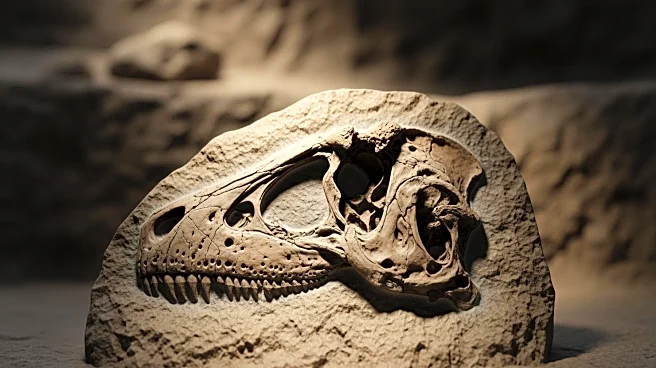
An international team of researchers has discovered a new dinosaur species, Foskeia pelendonum, in Vegagete, Spain. This small, plant-eating dinosaur lived during the Early Cretaceous period and is notable for its advanced skull despite its diminutive
size, measuring only about half a meter in length. The study, led by Paul-Emile Dieudonné from the National University of Río Negro, Argentina, suggests that Foskeia is closely related to the European herbivorous dinosaur group Rhabdodontidae. The fossils, discovered by Fidel Torcida Fernández-Baldor, were found to belong to at least five individuals, with the largest being a fully mature adult. The research highlights the dinosaur's unique anatomical features, which challenge existing ideas about ornithopod dinosaur evolution.
Why It's Important?
The discovery of Foskeia pelendonum is significant as it provides new insights into the evolutionary history of dinosaurs, particularly the ornithopod group. The findings suggest that miniaturization in dinosaurs did not equate to evolutionary simplicity, as evidenced by the complex skull structure of Foskeia. This challenges previous assumptions and fills a 70-million-year gap in the evolutionary record. The research also supports the revival of the Phytodinosauria grouping, which could reshape our understanding of plant-eating dinosaur evolution. The study underscores the importance of examining smaller and less obvious fossils to gain a comprehensive understanding of dinosaur evolution.
What's Next?
Future research will likely focus on further testing the hypothesis of Phytodinosauria with additional data. The unique features of Foskeia pelendonum may prompt paleontologists to re-evaluate other small dinosaur species and their evolutionary significance. Continued exploration and excavation in regions like Vegagete could uncover more fossils that provide further insights into the diversity and evolutionary pathways of early dinosaurs. The study also highlights the potential for new discoveries in less-studied areas, encouraging a broader scope of paleontological research.