


What's Happening?
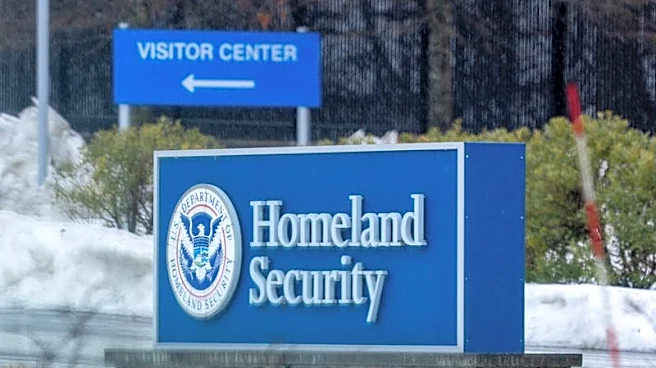
U.S. Immigration and Customs Enforcement (ICE) has informed Salt Lake City officials that it no longer intends to convert a recently purchased warehouse into a large-scale immigration detention center. The Department of Homeland Security (DHS) acquired
the warehouse at 6020 W. 300 South for $145.4 million earlier this year, with plans to establish a facility capable of holding up to 10,000 individuals. This reversal comes after Salt Lake City and County filed a lawsuit in June against DHS to block the development. Attorneys for all parties have requested a 60-day stay on the lawsuit, during which DHS has committed not to proceed with the conversion. The Salt Lake City warehouse was part of a planned $45 billion expansion of immigration detention centers nationwide. Uncertainty surrounding the project arose after DHS Secretary Kristi Noem was fired, and the agency began reviewing policies under newly sworn-in Secretary Markwayne Mullin.
Why It's Important?
This decision is a significant victory for local Democratic leaders, including Salt Lake City Mayor Erin Mendenhall and Salt Lake County Mayor Jenny Wilson, who vehemently opposed the detention center. Their concerns ranged from the potential strain on the city's water and sewer systems, increased air pollution, and an added burden on already stretched police resources. Mayor Mendenhall previously stated that such a facility had no place in Salt Lake City due to its 'inhumane nature' and the severe impacts on public health and safety. The reversal highlights the power of local government and community advocacy in influencing federal decisions, particularly on issues with substantial local impact. It also underscores the ongoing debate surrounding immigration detention policies and the role of federal agencies in local communities.
What's Next?
The U.S. District Court for the District of Utah is expected to approve the 60-day stay on the lawsuit. During this period, DHS intends to designate the Salt Lake Facility as 'excess property' for disposition by the General Services Administration, indicating a move to offload the property. This aligns with earlier reports by The New York Times that DHS planned to divest seven warehouses across the country. The long-term fate of the Salt Lake City warehouse remains to be determined, but the immediate threat of it becoming a large detention center has been averted. Local officials will likely monitor the situation closely to ensure DHS adheres to its stated intentions and to prevent any future attempts to revive the detention center plan.
Beyond the Headlines
The episode in Salt Lake City reflects a broader national tension between federal immigration enforcement priorities and local community concerns. The proposed detention center, part of a massive federal expansion, faced opposition not just on humanitarian grounds but also due to practical infrastructure and environmental impacts. This case could serve as a precedent for other communities facing similar federal projects, demonstrating that organized local resistance can lead to significant policy changes. It also brings to light the financial implications of such federal acquisitions, with the Salt Lake City warehouse being one of ICE's most expensive purchases, now slated to be offloaded. The incident underscores the complex interplay between federal agencies, local governments, and public sentiment in shaping national policy implementation.