







What's Happening?
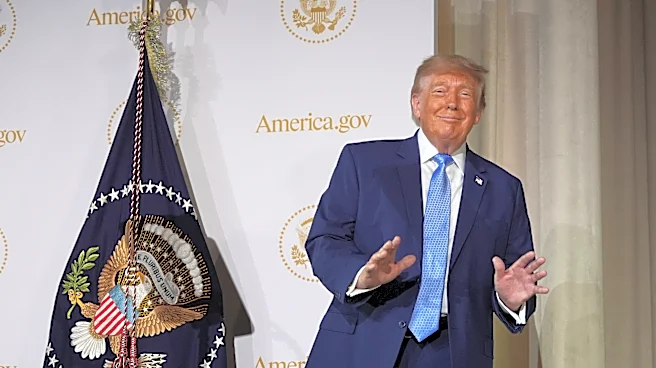
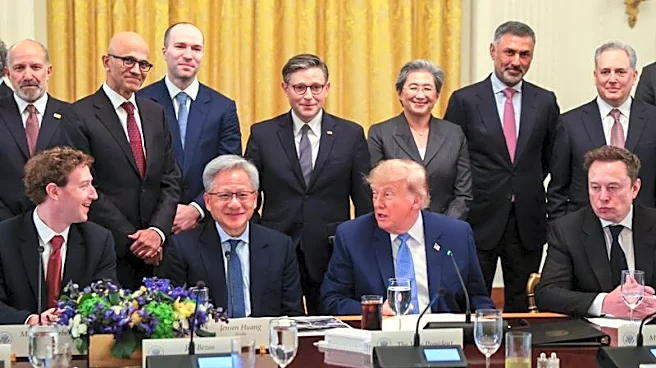
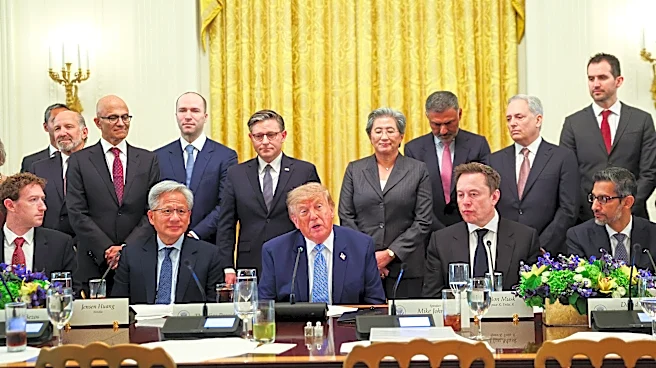
President Trump and several prominent AI industry leaders, including Mark Zuckerberg of Meta, Jensen Huang of Nvidia, and Dario Amodei of Anthropic, signed a voluntary 'Joint Commitment on Frontier Responsibilities' at the White House. This pledge aims
to implement more controls and safety measures in the rapid development of artificial intelligence. However, a photo of the signed agreement shared by President Trump on Truth Social revealed a misspelling of 'United States' as 'Unites States' directly beneath his signature. The pledge outlines commitments for companies to ensure their technology behaves as intended, promptly identify and resolve issues, and implement internal controls with independent board oversight. This gathering follows earlier calls from some AI leaders, such as OpenAI’s Sam Altman and Elon Musk, for a deceleration of AI advancements, which President Trump and Huang had previously rejected. Additionally, President Trump is mandating via executive order that all government departments and agencies change their phrasing from 'artificial intelligence' to 'superintelligence' or 'SI'.
Why It's Important?
The voluntary nature of this pledge raises questions about its effectiveness in regulating the fast-evolving AI industry. Without legal or regulatory ramifications for non-compliance, the commitment relies heavily on the goodwill and self-policing of the signatory companies. This approach could be seen as prioritizing the continuation of the AI boom over robust, enforceable safety measures. The misspelling on an official document signed by the President and top industry figures might suggest a lack of thoroughness or urgency in the drafting process, potentially undermining the perceived seriousness of the commitment. The shift in terminology from 'artificial intelligence' to 'superintelligence' by executive order could also have broader implications for how AI is discussed and perceived within government and public discourse, potentially influencing future policy and funding directions. The event highlights the ongoing tension between fostering innovation and ensuring safety in the rapidly advancing field of AI.
What's Next?
The immediate next steps will likely involve monitoring how the signatory companies implement the voluntary controls and safety measures outlined in the pledge. While the accord does not establish common mandatory thresholds, implementation deadlines, or penalties, it sets a precedent for industry self-regulation. Future discussions may focus on whether these voluntary commitments are sufficient or if more binding legislation will be necessary to address AI safety concerns. The executive order mandating the use of 'superintelligence' could lead to a re-evaluation of AI-related terminology across government agencies and potentially influence public understanding and expectations of AI capabilities. Stakeholders, including policymakers, industry leaders, and civil society groups, will likely continue to debate the balance between promoting AI development and establishing effective oversight mechanisms. The long-term impact of this voluntary pledge will depend on the industry's commitment to its principles and the government's willingness to consider more stringent regulations if self-policing proves inadequate.
Beyond the Headlines
The incident of the misspelled 'United States' on a high-profile document signed by the President and leading tech executives could be interpreted as a symbolic indicator of the broader challenges in regulating advanced technologies. It might suggest that the rapid pace of technological development and the urgency to appear proactive in addressing its implications can sometimes overshadow meticulous attention to detail and the establishment of robust, enforceable frameworks. This event also underscores the increasing influence of the technology industry on national policy, as evidenced by the White House gathering and the voluntary nature of the agreement. The reliance on industry self-regulation, while promoting innovation, could also raise ethical questions about accountability and transparency, especially given the potential societal impact of advanced AI. The shift to 'superintelligence' as a preferred term might reflect a desire to frame AI development in a more ambitious or even futuristic light, potentially influencing public perception and investment in the field, but also raising concerns about hype versus reality.