
What's Happening?
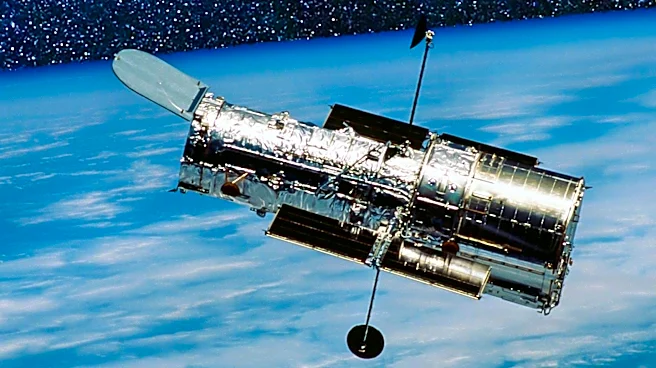
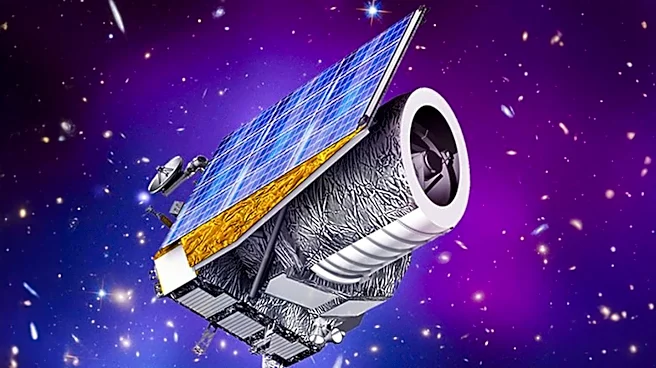
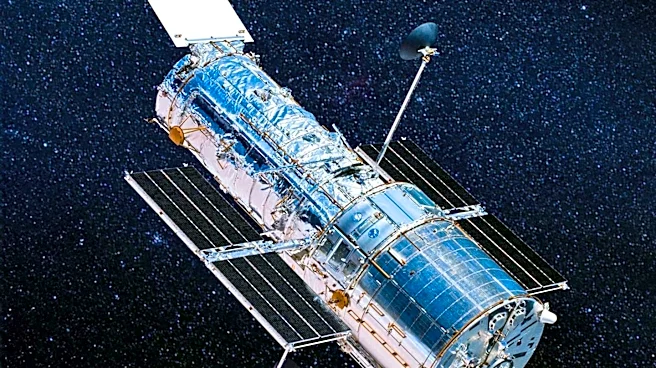
The Roman Space Telescope, formerly known as WFIRST (Wide Field Infrared Survey Telescope), possesses a field of view that is 100 times greater than that of the Hubble Space Telescope. This significant
advancement allows Roman to capture vast areas of the sky in a single observation. For instance, when observing the Pillars of Creation in the Eagle Nebula, Hubble can only focus on the pillars themselves. In contrast, Roman can simultaneously image the pillars along with substantial portions of the surrounding nebula. This capability enables a much broader survey of celestial objects and phenomena, providing a more comprehensive context for detailed observations. The European Space Agency (ESA) has highlighted this comparative advantage, indicating Roman's potential to revolutionize wide-field infrared astronomy.
Why It's Important?
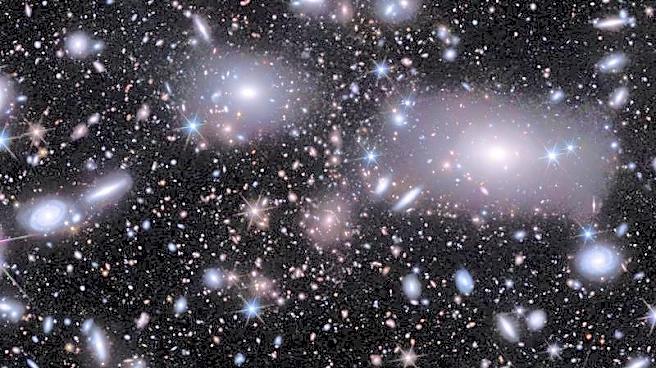
The vastly expanded field of view of the Roman Space Telescope is a critical development for astrophysics and cosmology. This capability allows scientists to conduct large-scale surveys of the universe much more efficiently than previously possible. By observing 100 times more sky in a single shot, Roman can map the distribution of galaxies, dark matter, and dark energy with unprecedented speed and scope. This will enable researchers to gather statistical data on cosmic structures, galaxy evolution, and exoplanets on a scale that was previously impractical. The ability to capture wider fields of view while maintaining high resolution means that astronomers can identify rare phenomena and study the broader environmental context of astronomical objects, leading to new discoveries and a deeper understanding of the universe's large-scale structure and evolution.
What's Next?
The Roman Space Telescope is poised to embark on a mission to survey the infrared sky, building upon its wide-field capabilities. Its observations are expected to generate massive datasets that will be analyzed by astronomers worldwide, leading to numerous scientific publications and discoveries. Future research will likely leverage Roman's ability to conduct large-scale surveys for gravitational lensing, which can map the distribution of dark matter, and to study the expansion history of the universe through observations of distant supernovae. The telescope will also play a crucial role in the search for exoplanets using microlensing techniques, which benefit significantly from a wide field of view. The data collected by Roman will complement observations from other advanced telescopes, such as the James Webb Space Telescope, providing a multi-wavelength and multi-scale view of the cosmos.
Beyond the Headlines
The development of telescopes like Roman, with their significantly wider fields of view, represents a paradigm shift in astronomical observation. While telescopes like Hubble and James Webb excel at detailed, high-resolution imaging of smaller regions, Roman's strength lies in its ability to provide a panoramic view of the cosmos. This complementary approach allows scientists to connect the dots between individual, highly resolved objects and the larger cosmic structures they inhabit. This broader perspective is essential for understanding phenomena that occur on vast scales, such as the cosmic web, the distribution of dark energy, and the statistical properties of galaxy populations. The technological advancements enabling such wide-field, high-resolution imaging also push the boundaries of detector technology and optical engineering, fostering innovation that can have broader applications beyond space exploration.