






What's Happening?
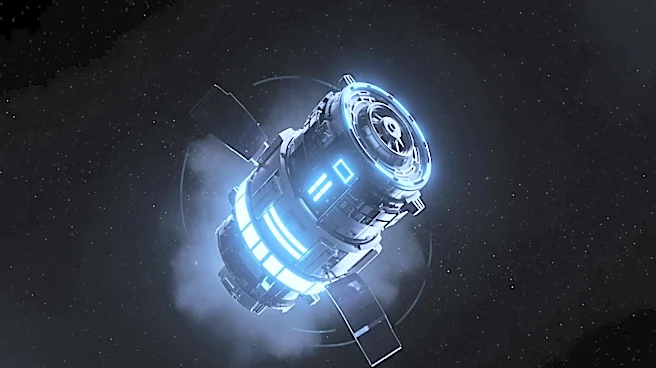
NASA's Psyche spacecraft, en route to the metallic asteroid 16 Psyche, recently conducted a strategic flyby of Mars, capturing rare images of the planet. The spacecraft approached Mars from a high angle, allowing it to photograph the planet as an illuminated
crescent. This maneuver was part of a trajectory adjustment to save propellant and boost the spacecraft's solar-electric propulsion system. During the flyby, Psyche came within 2,864 miles of Mars' surface, capturing thousands of images that included views of the planet's south pole and wind-scattered dust across its craters. These images are crucial for calibrating the spacecraft's instruments before it reaches the asteroid in 2029.
Why It's Important?
The Psyche mission is significant as it aims to study a metallic asteroid that may provide insights into the early building blocks of planetary cores, similar to those of Earth and Mars. The flyby of Mars not only aids in the spacecraft's journey by using the planet's gravity to increase speed but also provides valuable data for calibrating its instruments. This ensures that the spacecraft is well-prepared for its primary mission of mapping the asteroid. The images captured during the flyby offer a unique perspective of Mars, contributing to our understanding of the planet's surface and atmospheric conditions.
What's Next?
Following the successful flyby, the Psyche spacecraft is now on course to reach the asteroid 16 Psyche by the summer of 2029. Upon arrival, the spacecraft will enter an orbit that allows it to map the asteroid's surface and study its composition. This mission could potentially reveal whether the asteroid is the exposed core of an ancient planetary body, offering unprecedented insights into the formation of planets. The data collected will be crucial for scientists studying planetary formation and the history of our solar system.