




What's Happening?
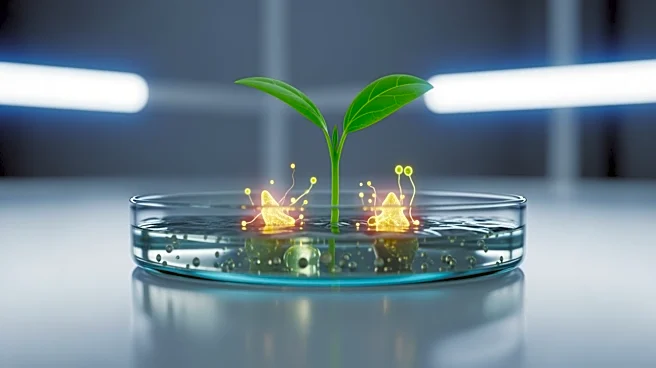
NASA's VEG-06 study, led by Principal Investigator Norman Lewis from Washington State University, examines how plants and beneficial bacteria interact in microgravity. The research focuses on plants like beans and peas that partner with specific bacteria to convert
atmospheric nitrogen into a usable form for growth. The study also investigates changes in lignin, a material that helps plants maintain structure on Earth. The experiment aims to determine if these plant-bacteria partnerships can form in space and track plant health and growth when relying on bacteria for nutrients.
Why It's Important?
Understanding plant-bacteria interactions in microgravity is crucial for developing sustainable agricultural practices in space. This research could lead to advancements in growing food during long-duration space missions, reducing the need for fertilizers on future Moon and Mars missions. Additionally, insights gained from this study may improve nitrogen fixation processes on Earth, benefiting agriculture and forestry by enhancing soil health and reducing dependency on chemical fertilizers. The findings could also contribute to economic advantages in planting nitrogen-fixing crops alongside other crops.
What's Next?
The VEG-06 study will continue to monitor plant growth and health in the microgravity environment of the ISS. Results from this research could inform future space missions and agricultural practices both in space and on Earth. NASA may explore further experiments to optimize plant growth in space, potentially leading to new methods for recycling inedible plant parts and supporting future space crops. The study's outcomes could also influence agricultural policies and practices aimed at improving sustainability and efficiency.