






What's Happening?
QuiX Quantum, in collaboration with Artilux Inc. and Brillink Inc., has secured funding under the TechBridge Taiwan Call 2026 to develop room-temperature, on-chip single-photon detectors. This 36-month project, named QSPAD, aims to create waveguide-based
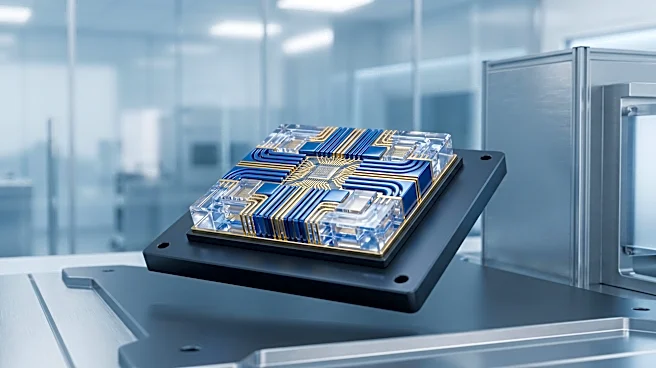
germanium-silicon (GeSi) single-photon avalanche diode (SPAD) arrays that can operate at or near room temperature, specifically down to -40 °C using conventional thermoelectric cooling. These detectors will be co-integrated with QuiX Quantum’s low-loss silicon nitride photonic integrated circuits. The current generation of photonic quantum computers relies on superconducting nanowire single-photon detectors that require extreme cryogenic cooling, below 2.5 Kelvin, which necessitates bulky and expensive cryogenic systems. The QSPAD project seeks to eliminate this cryogenic bottleneck, making quantum computing hardware more practical and deployable outside specialized laboratories.
Why It's Important?
The development of room-temperature single-photon detectors is a critical step towards scalable and fault-tolerant quantum computing. By removing the need for ultra-cold cryogenic systems, the QSPAD project addresses one of the most significant cost and logistical barriers to widespread quantum computer deployment. This innovation will enable photonic quantum systems to operate in environments where cryogenic cooling is impractical, such as commercial data centers and field-deployed quantum sensing applications. Eliminating the cryogenic requirement not only reduces the overall cost of quantum systems but also simplifies their integration into existing infrastructure. This advancement is crucial for QuiX Quantum's roadmap towards commercially deployable fault-tolerant systems beyond 2030, supporting the industrial foundations for increasingly scalable photonic quantum computers.
What's Next?
The QSPAD project is scheduled to run from January 2027 to December 2029, during which the partners will develop, integrate, and demonstrate the near-room-temperature photonically integrated single-photon detectors. These detectors are designed to be CMOS-compatible and sensitive at telecom wavelengths (1310/1550 nm), facilitating integration with existing optical communication infrastructure. The collaboration aims to translate system-level requirements for fault-tolerant quantum computing into manufacturable technology. This initiative is expected to strengthen the quantum-photonics supply chain by combining Taiwan’s leadership in GeSi detectors and advanced packaging with European manufacturing pathways. Successful completion of QSPAD will pave the way for QuiX Quantum's next-generation Dedalo architecture, which plans for loss-tolerant logical-qubit capabilities between 2028 and 2030.
Beyond the Headlines
This technological leap has profound implications beyond just quantum computing. The ability to detect single photons at room temperature could revolutionize various fields, including advanced sensing, secure communication, and medical imaging. For instance, highly sensitive, compact, and non-cryogenic single-photon detectors could enable new forms of quantum sensors for environmental monitoring or medical diagnostics that are currently unfeasible due to equipment size and cost. Furthermore, this project highlights the growing international collaboration in advanced technology, bridging Dutch and Taiwanese photonics ecosystems to tackle complex engineering challenges. The shift away from cryogenic cooling also aligns with broader trends towards energy efficiency and sustainability in high-tech industries, as it reduces the energy footprint associated with maintaining ultra-low temperatures.