






What's Happening?
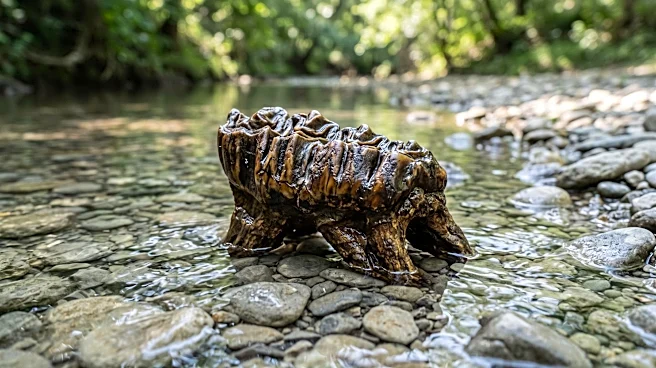
A fossilized tooth from a Pacific mastodon, an extinct elephant-like animal that inhabited North America during the Ice Age, has been discovered in a creek in San Mateo County, south of San Francisco. Geomorphologist Brigid Lynch found the 23cm long tooth partly
submerged in water during a habitat restoration project. Initially, the team was unsure of the find, but a reverse image search identified it as a Pacific mastodon molar fossil. The tooth is in remarkably good condition, with both its crown and root intact. Chrissy Garcia, curator at Stanford University's Geoscience Specimen Collection, noted that while the presence of mastodons and mammoths in the Bay Area during the Pleistocene Epoch was known, the manner of this discovery was surprising. The tooth has been donated to Stanford University, where researchers plan to determine its age and create a 3D copy for public education.
Why It's Important?
This discovery offers a valuable window into the prehistoric past of the San Francisco Bay Area and the broader Ice Age era in North America. The well-preserved mastodon tooth provides scientists with a rare opportunity to study an extinct species that roamed the region thousands of years ago. Research on the tooth at Stanford University will contribute to a deeper understanding of the Pleistocene Epoch's fauna and environment. Furthermore, the find underscores the critical role of protected open spaces in preserving archaeological and paleontological evidence of the region's distant history. As technology advances, this specimen could yield new research opportunities and help answer emerging scientific questions about ancient ecosystems and climate.
What's Next?
Researchers at Stanford University will proceed with determining the exact age of the mastodon tooth. Following this, a 3D copy of the fossil will be created, which will be used for public education, allowing a wider audience to engage with this significant discovery. The specimen is also expected to open new avenues for scientific inquiry as research technologies evolve. The ongoing analysis of the tooth could provide insights into the diet, habitat, and migratory patterns of Pacific mastodons, potentially revealing more about the environmental conditions of the Ice Age in California. The discovery may also encourage further exploration and protection of similar sites in the region.
Beyond the Headlines
The discovery of the mastodon tooth transcends its immediate scientific value by highlighting the profound connection between modern landscapes and deep geological time. It serves as a tangible link to a world that existed long before human settlement in the Bay Area, prompting reflection on the vast timescales of Earth's history and the continuous processes of environmental change. Ethically, the careful handling and donation of the fossil to a research institution like Stanford University emphasize the importance of responsible stewardship of natural heritage. Culturally, such finds enrich public understanding of natural history and can inspire future generations in scientific exploration and conservation efforts, reinforcing the idea that even seemingly ordinary creeks can hold extraordinary secrets from the past.