
What's Happening?
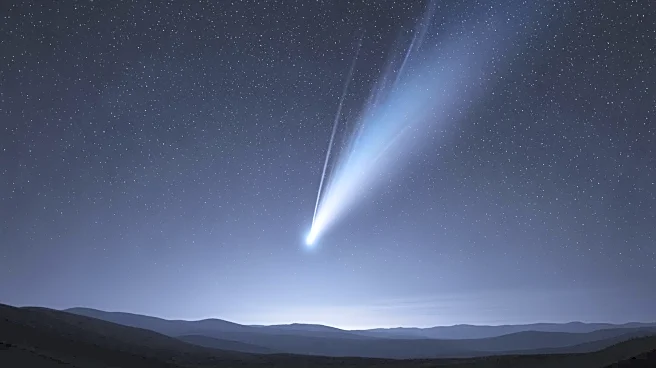
Astronomers have identified Comet C/2025 R3 (PanSTARRS), which is expected to become one of the brightest comets of 2026. The comet, discovered by the Panoramic Survey Telescope and Rapid Response System
in Hawaii, has a long orbital period and will make a close approach to Earth in April 2026. It is anticipated to be visible to the naked eye, providing a rare opportunity for skywatchers to observe a celestial event without advanced equipment. The comet will reach its closest point to the Sun on April 20, 2026, and its closest approach to Earth on April 27, 2026.
Why It's Important?
The appearance of Comet C/2025 R3 offers a unique opportunity for both amateur and professional astronomers to study a comet with a long orbital period. Such events can provide insights into the composition and behavior of comets, which are remnants from the early solar system. Observing the comet's trajectory and brightness can also help refine models of cometary dynamics and improve predictions for future comet appearances. For the general public, the comet's visibility presents an exciting chance to engage with astronomy and witness a rare celestial phenomenon.
What's Next?
As the comet approaches, astronomers will continue to monitor its brightness and trajectory to provide updated viewing guidance. Skywatchers are advised to look for the comet in the constellation Pisces, particularly around April 17, when a New Moon will provide darker skies for better visibility. Observers are encouraged to use mobile astronomy apps to locate the comet and to find viewing locations away from city lights for optimal conditions. The comet's appearance will be a highlight of the astronomical calendar, drawing interest from both seasoned stargazers and the general public.