





What's Happening?
University of South Dakota (USD) archaeology students are actively engaged in fieldwork at the Bear Butte Creek Historic Preserve, an 180-acre site in South Dakota that encompasses Native American cultural artifacts and the historical remnants of Fort
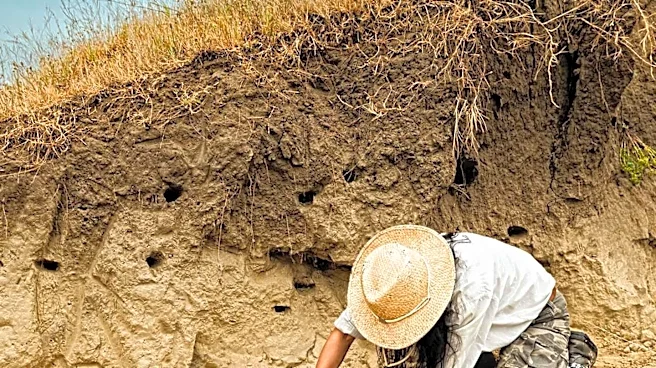
Meade. This marks the third consecutive year USD students have participated in excavations at Fort Meade's 'Soap Suds Row,' the former living quarters of Army laundresses. These laundresses, whose contributions to military life have historically been overlooked, performed essential duties such as cleaning uniforms, preparing food, and caring for children. The ongoing digs aim to uncover artifacts connected to these women and their families, providing valuable insights into their daily lives. Approximately 34 students have participated in the Fort Meade field school over the past three years, gaining hands-on archaeological training that cannot be replicated in a classroom setting. This year's expedition yielded around 200 bags of artifacts, ranging from large individual items to numerous tiny fragments, all of which are transferred to the new USD Archaeology Laboratory (ARCHLAB) for further study and cataloging before curation at the state's Archeological Research Center in Rapid City.
Why It's Important?
This archaeological project is significant for several reasons, offering both educational and historical benefits. For USD students, it provides invaluable practical experience, preparing them for careers in anthropology and archaeology. Many participants have gone on to pursue graduate-level studies or secure full-time positions in the field, demonstrating the program's effectiveness in workforce development. Historically, the excavation of 'Soap Suds Row' sheds light on the often-forgotten contributions of Army laundresses, humanizing individuals whose roles were crucial to military life but rarely documented. The artifacts, which include fragments of cosmetic bottles, buttons, shoe fragments, ceramics, and machinery, offer a tangible connection to the routines, personal lives, and families of those who lived at Fort Meade in the late 19th and early 20th centuries. This research enriches the understanding of the Dakota Territory's history and the social dynamics within military outposts, contributing to a more complete historical narrative.
What's Next?
The archaeological work at the Bear Butte Creek Historic Preserve is set to continue for the foreseeable future. During next summer's trip, Professor Krus and his students plan to collect samples from additional sites within the preserve for comparative analysis. Student interns have already surveyed approximately 160 acres and identified 20 new archaeological sites of interest, indicating a rich potential for future discoveries. The ongoing support from Historic Deadwood and the Black Hills Community Foundation will be crucial for the continuation of this project. In the immediate future, the 200 bags of artifacts collected this year will undergo meticulous cleaning, research, and cataloging at the USD ARCHLAB. This process involves not only identifying the artifacts but also researching their historical context, which can transform seemingly insignificant scraps into valuable historical insights. The findings will then be prepared for curation at the state's Archeological Research Center, making them accessible for broader study and preservation.
Beyond the Headlines
Beyond the immediate findings, this project highlights the broader ethical and cultural dimensions of historical research. By focusing on 'Soap Suds Row,' the initiative actively works to rectify historical oversights, giving voice and recognition to a marginalized group—the Army laundresses—whose contributions were vital but often unacknowledged. This effort underscores the importance of inclusive historical narratives that move beyond traditional military accounts to encompass the lives of all individuals who shaped the past. The hands-on training provided to students also fosters a deeper appreciation for the meticulous nature of archaeological work and the ethical responsibilities involved in preserving cultural heritage. The process of identifying and interpreting artifacts, as described by Professor Krus, demonstrates how seemingly mundane objects can reveal profound insights into human lives, routines, and social structures, thereby enriching our collective understanding of history and identity. This project serves as a model for how academic institutions can contribute to both education and the preservation of local and national history.