



What's Happening?
Astronomers are exploring the possibility of nonspherical exoplanets, noting that while gravity typically molds planets into a roughly spherical shape, other factors can cause deviations. Composition (rocky or gassy) and rotation rate are key influences.
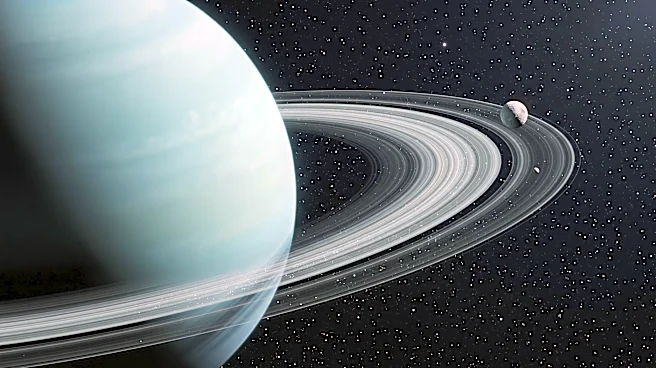
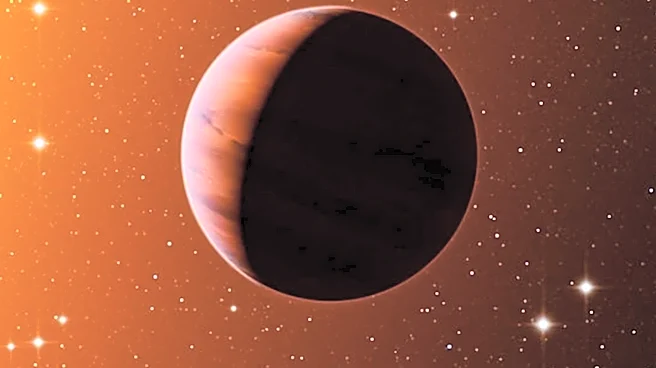
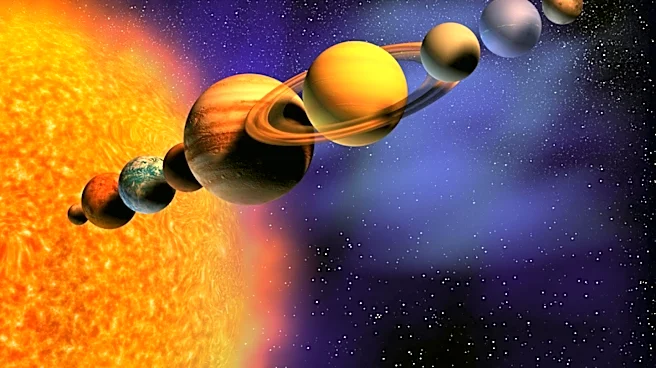
Faster-spinning planets tend to bulge at their equator, a phenomenon observed in our solar system's gas giants like Jupiter (nearly 7% thicker at its equator) and Saturn (10.7% thicker). Ice giants Uranus and Neptune also exhibit smaller bulges. Beyond our solar system, exoplanets, particularly 'hot Jupiters' orbiting very close to their stars, can experience extreme conditions. For example, WASP-121 b is stretched into a football shape by intense gravitational forces from its host star. If it were closer, it could be ripped apart. Some of these exoplanets, including WASP-69 b and KELT-9 b, also display puffed-up atmospheres and comet-like tails due to high-energy radiation from their stars.
Why It's Important?
The study of nonspherical exoplanets is important for advancing our understanding of planetary formation and evolution. Observing these extreme shapes provides crucial data on the powerful gravitational and radiative forces at play in diverse planetary systems. This research helps refine models of how planets interact with their host stars and how these interactions can dramatically alter a planet's physical characteristics and atmospheric composition. For the U.S. scientific community, particularly NASA and academic institutions involved in exoplanet research, these findings contribute to the broader goal of identifying potentially habitable worlds and understanding the vast diversity of planets beyond our solar system. It also highlights the capabilities of advanced telescopes like ALMA and JWST in uncovering new layers of planetary structures and dynamics.
What's Next?
Future research will likely involve continued observations of exoplanets using advanced telescopes to identify more examples of nonspherical worlds and to study their properties in greater detail. Astronomers will aim to correlate planetary composition, rotation rates, and orbital characteristics with observed deformations to build more comprehensive models. The focus will also be on understanding the long-term stability of these tidally-stressed planets and the processes that lead to atmospheric escape and the formation of comet-like tails. While pear-shaped exoplanets are not currently observed to the extent of significant visual deformation, ongoing advancements in imaging and data analysis might reveal more subtle irregularities, further refining our understanding of planetary mechanics.
Beyond the Headlines
The concept of nonspherical planets challenges our intuitive understanding of celestial bodies as perfect spheres, pushing the boundaries of astronomical imagination. It underscores the extreme and diverse conditions that can exist in the universe, far beyond the relatively stable environment of our solar system. This research not only expands scientific knowledge but also fuels public interest in space exploration and the search for life. The discovery of planets like WASP-121 b, stretched into a football shape, highlights the immense power of gravitational forces and the dynamic interplay between stars and their orbiting worlds, offering a glimpse into the violent and beautiful cosmic ballet that shapes planetary systems.