







What's Happening?
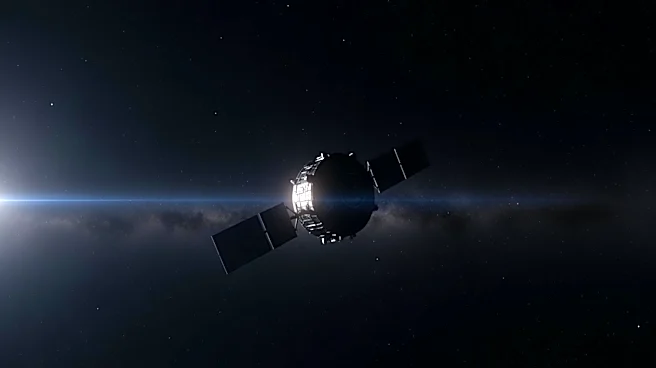
NASA has officially declared its MAVEN spacecraft, which was orbiting Mars, as dead after six months of radio silence. The spacecraft, launched in 2013, was designed to study the Martian atmosphere. It mysteriously stopped communicating in early December
after passing behind Mars. Data suggested that MAVEN went into a fast spin, disrupting its orbit and depleting its batteries. A NASA review board concluded that the spacecraft is irrecoverable. Despite its loss, MAVEN is expected to remain in orbit for 50 to 100 years before eventually crashing into Mars. The spacecraft had been instrumental in studying Martian weather and relaying data from NASA's Curiosity and Perseverance rovers.
Why It's Important?
The loss of MAVEN marks the end of a significant mission that contributed to the understanding of Mars' atmosphere and climate. The spacecraft's data has been crucial for scientists studying the planet's evolution and weather patterns. Its absence will require other spacecraft to fill the gap in data relay and atmospheric study. The incident highlights the challenges of long-term space missions and the potential for unexpected technical failures. The continued investigation into the cause of MAVEN's failure may provide insights to prevent similar issues in future missions.
What's Next?
NASA will rely on four other spacecraft orbiting Mars, including two from the U.S. and two from Europe, to continue the work previously handled by MAVEN. These spacecraft will ensure that there is no loss in rover science data. The ongoing investigation into MAVEN's failure may lead to improvements in spacecraft design and mission planning. The scientific community will continue to analyze the data collected by MAVEN to further understand Mars' atmospheric conditions.