





What's Happening?
A recent study published in Science Advances proposes a new model for the magnetic field generation of Ganymede, Jupiter's largest moon. Traditionally, it was believed that Ganymede's magnetic field was generated by convection in a fully formed core.
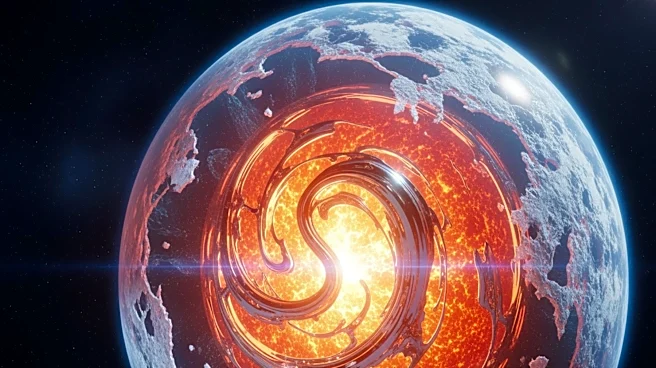
However, the new model suggests that the core is still forming, and this ongoing formation is responsible for the magnetic field. The study indicates that the process involves 'iron snow' convection, where solidified iron flakes fall through the liquid core, creating a magnetic field. This finding challenges previous assumptions and suggests that Ganymede's core formation is a slow, ongoing process, unlike other celestial bodies that have completed core formation and no longer generate magnetic fields.
Why It's Important?
Understanding Ganymede's magnetic field has broader implications for planetary science and the study of celestial bodies. The findings could reshape theories about the thermal evolution and magnetic field generation of moons and planets. This research may also provide insights into the conditions necessary for sustaining magnetic fields, which are crucial for protecting atmospheres and potentially supporting life. The study's implications extend to other moons, such as Europa and Callisto, offering a comparative framework for understanding their geological and magnetic histories.
What's Next?
Future research may focus on further refining the models of Ganymede's core formation and exploring similar processes in other celestial bodies. Observations from upcoming space missions could provide additional data to test these models. The study opens new avenues for investigating the magnetic properties of other moons and planets, potentially leading to a deeper understanding of their evolution and the conditions that sustain magnetic fields.