










What's Happening?
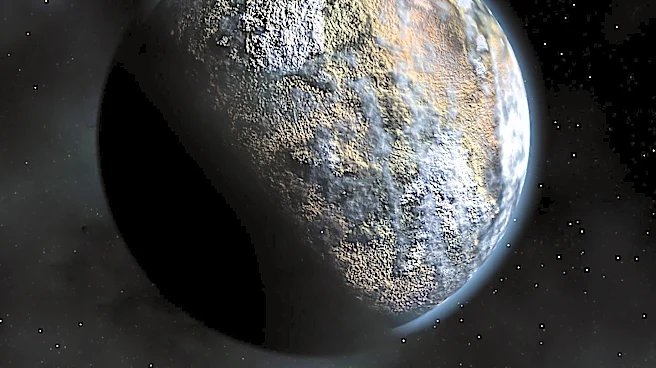
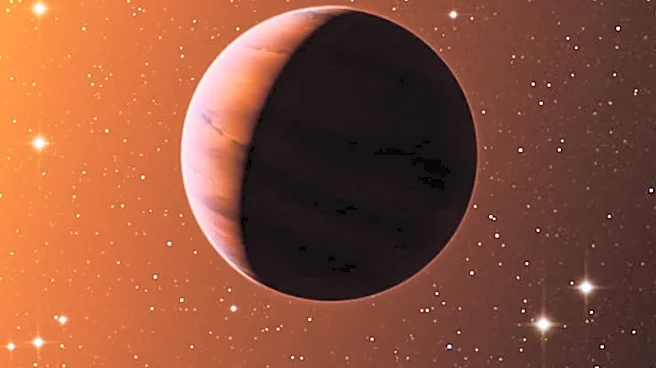
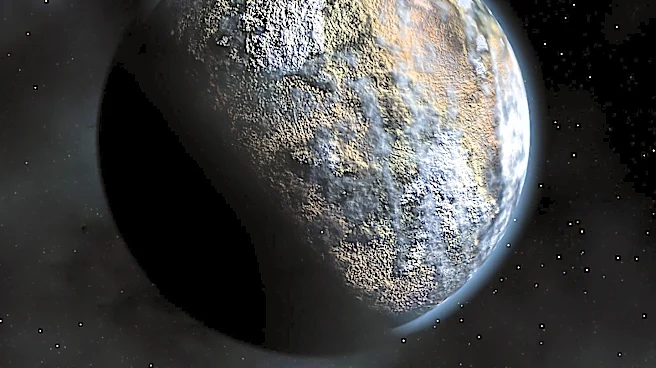
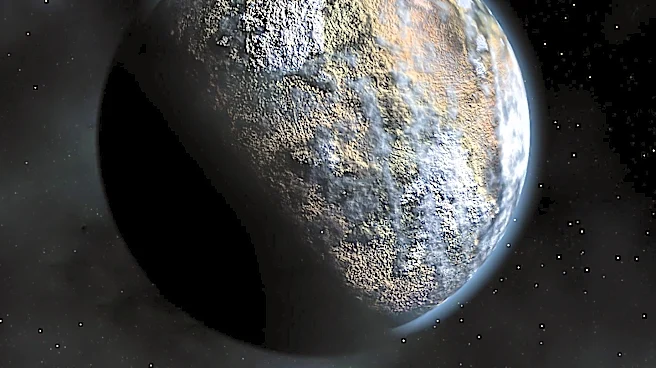
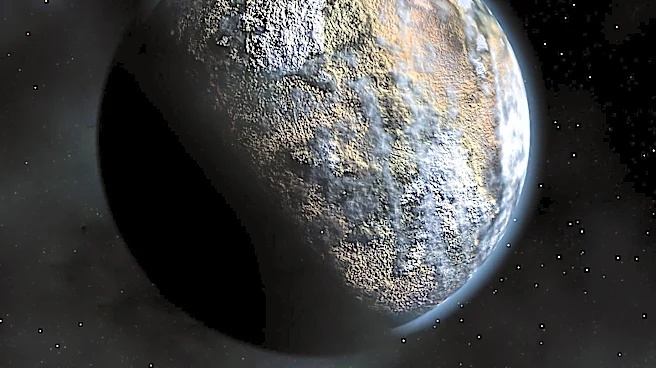
An international team of astronomers has made a groundbreaking discovery by detecting an atmosphere on the rocky exoplanet LHS 1140 b, located 48 light-years from Earth. This planet, considered a 'super-Earth,' was originally discovered in 2017 and is notable
for its mass, which is 5.6 times that of Earth, and a radius 70% larger. It orbits a cool red dwarf star, LHS 1140, completing its orbit every 24.7 days. The detection was made using the WINERED spectrograph on the Magellan Clay telescope in Chile, which identified helium escaping from the planet's atmosphere during a stellar transit. This marks the first time an atmosphere has been directly detected on a rocky planet in the habitable zone, a region where conditions may allow for liquid water, a key ingredient for life.
Why It's Important?
The discovery of an atmosphere on LHS 1140 b is significant as it expands our understanding of potentially habitable planets outside our solar system. The presence of an atmosphere suggests that the planet could support liquid water, making it a prime candidate for further study in the search for extraterrestrial life. This finding challenges previous assumptions that planets orbiting red dwarf stars, which emit intense radiation, could not maintain atmospheres. The ability of LHS 1140 b to retain its atmosphere over billions of years provides hope that other rocky exoplanets might also have the conditions necessary to support life. This discovery could influence future astronomical research and the development of technologies aimed at detecting life beyond Earth.
What's Next?
The detection of an atmosphere on LHS 1140 b positions it as a preferred target for future observations. Researchers plan to use advanced telescopes, such as the James Webb Space Telescope, to gather more precise data about the planet's atmosphere and surface characteristics. These studies aim to better understand the planet's potential to host life and to assess the possibility of life existing on similar worlds. The ongoing research will focus on characterizing the planet's internal structure and atmospheric composition, which could provide insights into the habitability of distant planets.