
What's Happening?
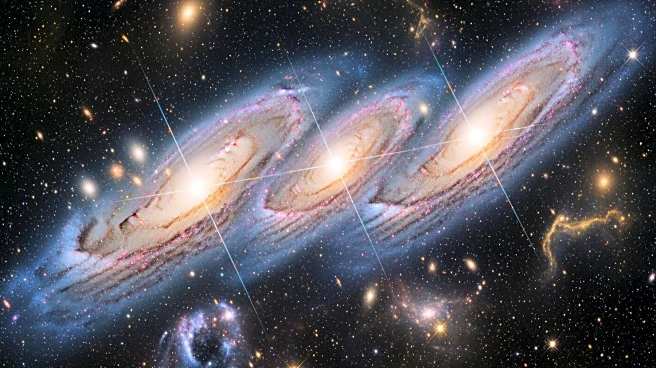
Astronomers have identified a rare cosmic event involving three galaxies merging, each hosting an active supermassive black hole. This event, located 1.2 billion light-years from Earth and named J1218/1219+1035,
was initially detected by the Wide-field Infrared Survey Explorer. Follow-up observations confirmed the presence of active galactic nuclei (AGN) in all three galaxies, which are separated by significant distances. The discovery marks only the third known instance of such a triple AGN system in the nearby universe, and the first where all three AGNs are radio-bright. This finding provides a unique opportunity to study the growth of galaxies and their black holes.
Why It's Important?
The discovery of this triple galaxy merger is significant as it offers insights into the processes that drive galaxy and black hole growth. Galaxy mergers are a primary mechanism for such growth, and observing a triple merger in action provides a rare opportunity to study these dynamics in detail. The presence of active supermassive black holes in all three galaxies adds to the rarity and scientific value of the event. Understanding these processes can help astronomers develop better models of galaxy evolution and the role of black holes in shaping the universe.
What's Next?
Astronomers plan to conduct further observations across multiple wavelengths to gain a deeper understanding of the triple merger system. These studies aim to uncover more about the interactions between the galaxies and their black holes, potentially revealing new insights into the life cycles of supermassive black holes. The findings could also aid in identifying other similar systems that may be hidden in the universe, enhancing our understanding of cosmic evolution.