






What's Happening?
A recent study conducted by researchers at the University of Santiago de Compostela and Spain’s National Research Council (CSIC) has revealed that eucalyptus plantations in Spain, initially planted for economic benefits, are detrimental to local biodiversity.
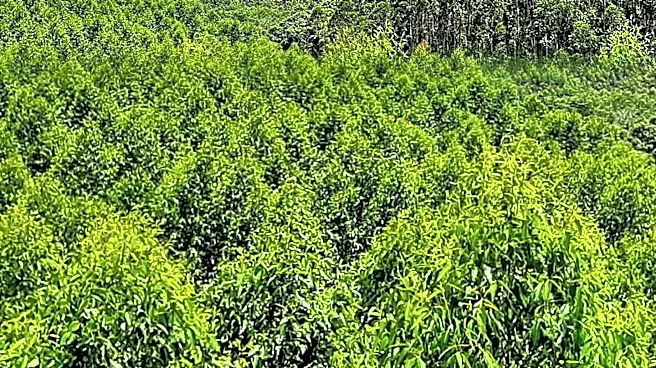
These plantations, which were established to support the paper and timber industries, have been found to function as 'green deserts.' This term describes areas that appear lush but support significantly less wildlife compared to native forests. The study, published in the journal Forest Ecology and Management, examined 240 sites around Fragas do Eume Natural Park in Galicia. It found that areas with a higher proportion of eucalyptus trees had lower bird species diversity. The research highlights that eucalyptus plantations, managed as single-species timber crops, provide a simpler habitat that cannot support the complex ecological roles of native woodlands.
Why It's Important?
The findings of this study are significant as they highlight the ecological cost of prioritizing economic gains over environmental health. Eucalyptus plantations, while economically beneficial, particularly in Galicia where they contribute approximately $2.9 billion annually and support over 19,000 jobs, pose a threat to biodiversity. The reduction in bird species diversity can have cascading effects on the ecosystem, affecting insects, reptiles, amphibians, and small mammals. The study underscores the need for a balanced approach that considers both economic and ecological factors in land management. The expansion of eucalyptus plantations, which now cover about 30% of the forested land in northwest Spain, raises concerns about the long-term sustainability of these ecosystems.
What's Next?
The study suggests a need for policy interventions to manage the ecological impact of eucalyptus plantations. This could involve implementing measures to protect native species and habitats, possibly by integrating more diverse plant species into these areas. The findings may prompt discussions among policymakers, environmentalists, and industry stakeholders about sustainable forestry practices. There may also be increased advocacy for the preservation of native forests and the restoration of biodiversity in affected areas. The economic reliance on eucalyptus plantations in regions like Galicia will require careful consideration to balance economic interests with environmental sustainability.
Beyond the Headlines
The study highlights a broader issue of how non-native species can disrupt local ecosystems. The introduction of eucalyptus trees, native to Australia, has led to a decline in native plant and animal species due to their inability to adapt to the new environment. This situation exemplifies the challenges of managing invasive species and the importance of maintaining ecological integrity. The research also points to the potential for allelopathy, where chemicals released by eucalyptus trees inhibit the growth of other plants, further reducing biodiversity. These findings may encourage further research into the ecological impacts of other non-native species and inform global conservation strategies.