



What's Happening?
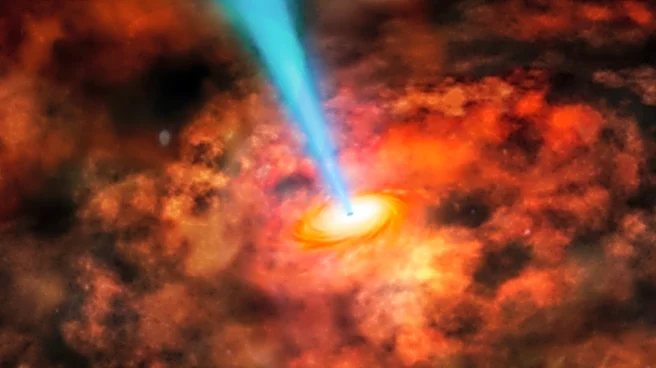
New research delves into the formation and evolution of magnetically charged black holes within the framework of Grand Unified Theories (GUTs). These theories, which aim to unify fundamental forces, predict the existence of magnetic monopoles and, under
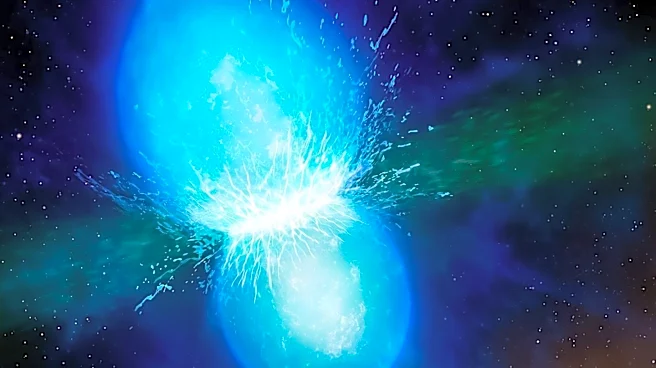
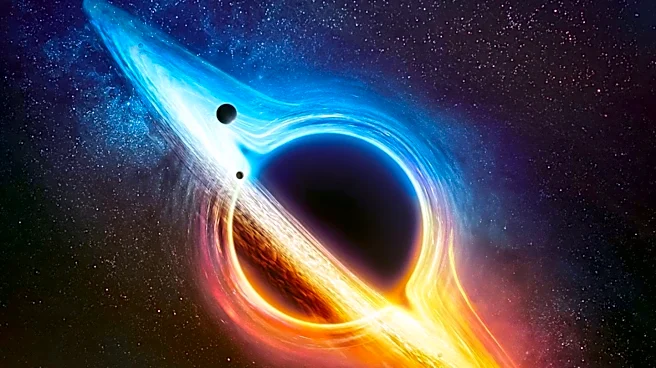
certain conditions, domain walls. The study suggests that when these domain walls collapse, they can form magnetically charged black holes. The mass and charge of these black holes are critically dependent on a parameter denoted as epsilon (ε), which relates to the cubic coupling in the scalar potential. For very small values of ε, the black holes can be astrophysically heavy, while larger values lead to extremal black holes with masses on the order of grams. The research also examines how the interaction of domain walls and monopoles can bind magnetic charge to the walls, potentially offering a solution to the cosmological monopole over-abundance problem. The cosmological evolution of these domain walls is analyzed, considering scenarios with strong or negligible friction, and their annihilation times are estimated based on the parameter ε.
Why It's Important?
This research is important for advancing our understanding of fundamental physics and the early universe. Grand Unified Theories are a cornerstone of theoretical physics, attempting to reconcile different forces of nature. The prediction and study of magnetically charged black holes within this context could provide testable hypotheses for future astrophysical observations or particle accelerator experiments. If confirmed, the existence of such black holes would offer profound insights into the nature of spacetime, gravity, and electromagnetism at extreme scales. Furthermore, the proposed mechanism for solving the cosmological monopole problem, a long-standing issue in cosmology, could have significant implications for our understanding of the universe's composition and evolution. The study's detailed analysis of domain wall dynamics and their role in black hole formation contributes to a more complete picture of cosmic processes in the very early universe.
What's Next?
Future research will likely focus on refining the theoretical models and exploring potential observational signatures of these magnetically charged black holes. Scientists may seek to identify specific astrophysical phenomena or cosmological data that could either support or refute the predictions of this research. Further investigation into the parameter ε and its precise influence on black hole properties will be crucial. Additionally, the implications for the cosmological monopole problem will continue to be explored, potentially leading to new avenues for understanding the early universe's particle content. Experimental efforts in particle physics, such as those at the Large Hadron Collider, might also indirectly contribute by testing aspects of Grand Unified Theories, which could, in turn, inform the understanding of these theoretical black holes.
Beyond the Headlines
The concept of magnetically charged black holes pushes the boundaries of our current understanding of physics, intertwining cosmology, quantum field theory, and general relativity. Beyond their direct implications for GUTs, these theoretical objects challenge our conventional notions of black holes, which are typically considered to be characterized only by mass, charge, and angular momentum. The existence of a magnetic charge would introduce a new fundamental property, potentially leading to novel interactions with magnetic fields and matter in the universe. This research also highlights the intricate relationship between microscopic particle physics and macroscopic cosmic structures, suggesting that phenomena at the smallest scales can have profound effects on the largest scales. The ongoing quest to unify fundamental forces continues to generate fascinating and complex theoretical constructs that could reshape our understanding of reality.