



What's Happening?
Goumbook, a social enterprise led by Tatiana Antonelli Abella, has launched the MENA Regenerative Agriculture Initiative to address agricultural challenges in the Middle East and North Africa (MENA) region. The initiative aims to promote regenerative
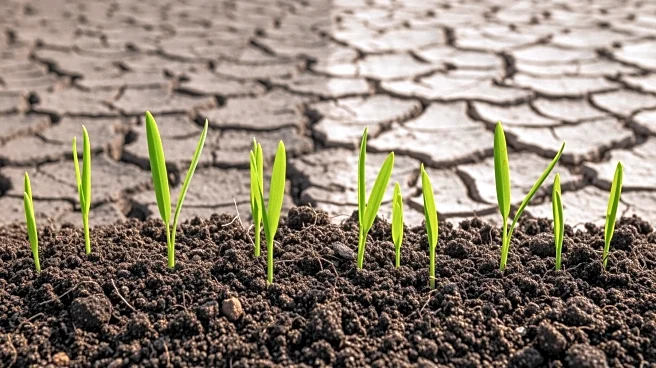
agriculture practices tailored to the region's arid climate, characterized by limited arable land and severe water scarcity. The program is supported by partnerships with HSBC, Saudi Awwal Bank, and the European Institute of Innovation & Technology, among others. It seeks to create a regional movement by mobilizing stakeholders, fostering innovation, and supporting farmer transitions to sustainable practices. The initiative also includes a Venture Programme to accelerate early-stage innovations and a summit to discuss policy and implementation strategies.
Why It's Important?
The initiative is significant as it addresses the urgent need for sustainable agricultural practices in a region facing extreme environmental constraints. With the MENA region projected to have a population of 724 million by 2050, the demand for food will increase, while the region has less than 5% arable land and only 1% of global freshwater resources. By focusing on regenerative agriculture, the initiative aims to improve soil health, enhance water retention, and increase crop resilience, which are crucial for food security and economic stability. The program's success could position MENA as a leader in climate-resilient agriculture, offering solutions that could be adapted globally as other regions face similar challenges.
What's Next?
Goumbook plans to continue its role as a mobilizer and ecosystem builder, focusing on education, advocacy, research, and scaling of regenerative practices. The organization aims to establish a regional open-source soil database and support farmers in transitioning to sustainable practices. An annual summit will serve as a platform for stakeholders to convene and discuss advancements in arid climate agriculture. The initiative's long-term goal is to position MENA as a global center of excellence for climate-resilient agriculture by 2035, aligning with international climate action milestones.
Beyond the Headlines
The initiative highlights the need for systemic change in agricultural practices, emphasizing the importance of local knowledge and traditional methods alongside modern technology. It also underscores the potential for regenerative agriculture to contribute to carbon sequestration, with soil health playing a critical role in capturing carbon emissions. The program's focus on building a supportive ecosystem and addressing policy misalignments could serve as a model for other regions facing similar environmental and economic challenges.