








What's Happening?
A recent analysis by Newsweek highlights significant regional disparities in housing market accessibility across the United States. The study, based on the Newsweek American Dream Index, evaluates 33,772 U.S. ZIP codes on their ability to provide affordable
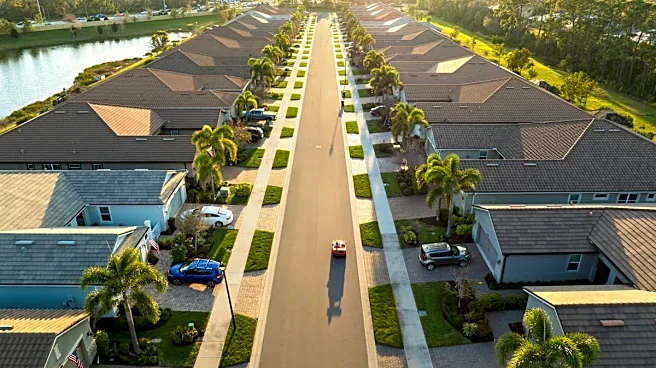
housing. The index assigns scores from 0 to 100, with higher scores indicating better housing access. The analysis reveals that counties in the South and Midwest generally offer more affordable housing options, attributed to higher construction rates and lower demand. In contrast, coastal areas in the Northeast and West face high home prices and limited inventory due to high demand and restrictive zoning laws. The study identifies Los Alamos County, NM, and Hanson County, SD, among others, as having the highest housing access scores, while counties like Kings County, NY, and San Francisco County, CA, have the lowest.
Why It's Important?
The findings underscore a growing regional divide in the U.S. housing market, with significant implications for economic mobility and the realization of the American dream. High housing costs in coastal areas are driven by job concentration and limited supply, making homeownership unattainable for many. This situation exacerbates economic inequality, as high earners continue to drive up prices, pushing lower-income residents out of urban centers. Conversely, the affordability in the South and Midwest could attract more residents and businesses, potentially shifting economic power and population growth to these regions. Understanding these dynamics is crucial for policymakers and stakeholders aiming to address housing affordability and promote equitable economic development.
What's Next?
As housing affordability continues to be a pressing issue, policymakers may need to consider reforms in zoning laws and construction regulations to increase housing supply in high-demand areas. Additionally, there could be increased investment in infrastructure and job creation in more affordable regions to balance economic opportunities across the country. Stakeholders, including government agencies, developers, and community organizations, may collaborate to develop strategies that address both the supply and demand sides of the housing market, ensuring that housing remains accessible to a broader segment of the population.
Beyond the Headlines
The regional disparities in housing access also reflect broader socio-economic trends, such as urbanization and the concentration of high-paying jobs in specific areas. These trends raise questions about sustainable urban development and the role of public policy in managing growth. The challenge lies in balancing economic development with the need for affordable housing, which may require innovative solutions such as mixed-use developments and public-private partnerships. Additionally, the cultural and social implications of these disparities, including community displacement and changes in neighborhood demographics, warrant further exploration.