
What's Happening?
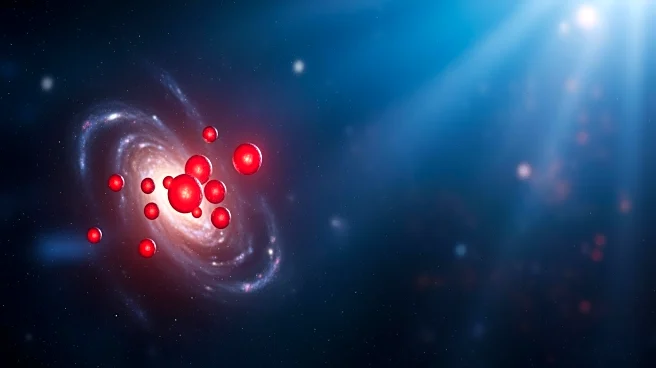
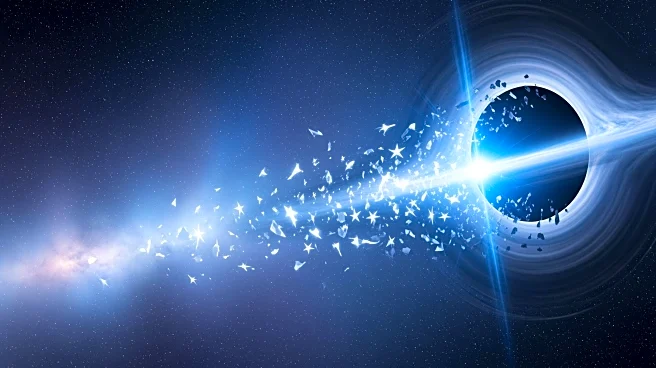
Recent research has identified the source of rare, short-lived blue light events, known as luminous fast blue optical transients (LFBOTs), as black holes destroying nearby stars. The study focused on a signal called AT 2024wpp, detected in 2024, which
is the brightest example of its kind. This event, located 1.1 billion light-years away, released significantly more energy than typical supernovae and faded quickly. The research concluded that AT 2024wpp resulted from a tidal disruption event, where a black hole pulls a star apart. The findings suggest that LFBOTs occur under specific conditions involving smaller black holes and massive companion stars, challenging previous models that attributed these events to standard stellar explosions.
Why It's Important?
This discovery provides critical insights into the processes behind LFBOTs, refining our understanding of how black holes interact with their surroundings. The identification of black holes as the source of these powerful flashes could lead to a reevaluation of models related to stellar explosions and black hole behavior. The study highlights the role of black holes in shaping the dynamics of galaxies and the distribution of matter in the universe. By understanding these events, astronomers can better predict and interpret similar phenomena, enhancing our knowledge of cosmic evolution and the lifecycle of stars.
What's Next?
The research team plans to continue observing LFBOTs to further understand the conditions that lead to these events. Future studies will focus on identifying other instances of tidal disruption events and exploring their characteristics. The findings will guide future observations and help refine models of black hole interactions. As more data becomes available, scientists aim to develop a comprehensive framework for predicting and analyzing LFBOTs, potentially leading to new discoveries about the universe's most extreme environments.