





What's Happening?
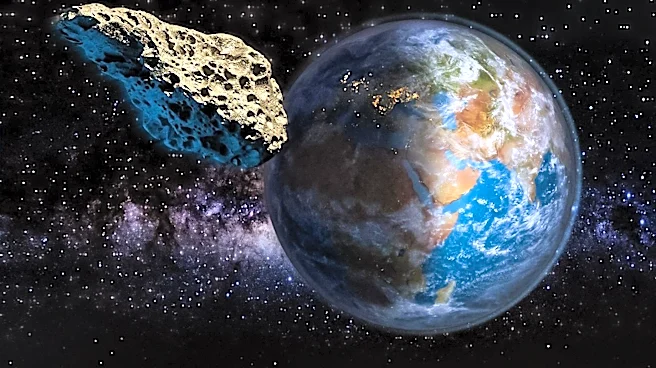
A massive asteroid, designated 1997 NC1, is set to pass by Earth this weekend without posing any threat. The asteroid, discovered nearly three decades ago by an asteroid-tracking system in Hawaii, measures between 2,461 feet and 5,413 feet in width, comparable
to the size of two to four Empire State Buildings. According to the European Space Agency, the asteroid will make its closest approach on Saturday morning, coming within 1.6 million miles of Earth. This event provides an opportunity for skygazers equipped with binoculars or small telescopes to observe the asteroid as a small point of light in the sky. The asteroid will not come this close to Earth again until 2133. NASA and other space agencies continue to monitor such celestial objects to ensure Earth's safety from potential collisions.
Why It's Important?
The passage of asteroid 1997 NC1 highlights the ongoing efforts by NASA and other space agencies to track near-Earth objects (NEOs) and assess any potential threats they may pose. While this particular asteroid poses no danger, the monitoring of such objects is crucial for planetary defense. The ability to predict and track the paths of asteroids allows scientists to develop strategies to mitigate potential impacts, safeguarding the planet. This event also underscores the importance of international collaboration in space exploration and safety, as agencies like NASA and the European Space Agency work together to monitor and share data on NEOs.
What's Next?
As asteroid 1997 NC1 passes by Earth, scientists will continue to observe and gather data to refine their understanding of its trajectory and characteristics. This information will contribute to the broader database of NEOs, enhancing predictive models and improving future monitoring efforts. The event also serves as a reminder of the need for continued investment in space observation technologies and international cooperation to address potential asteroid threats. Public interest in such celestial events may also inspire educational initiatives and public outreach to raise awareness about space science and planetary defense.