




What's Happening?
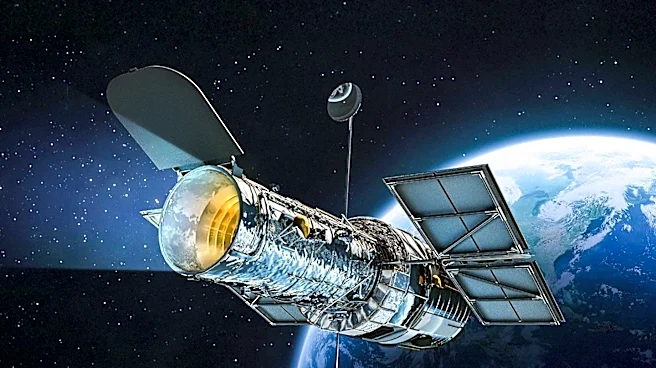
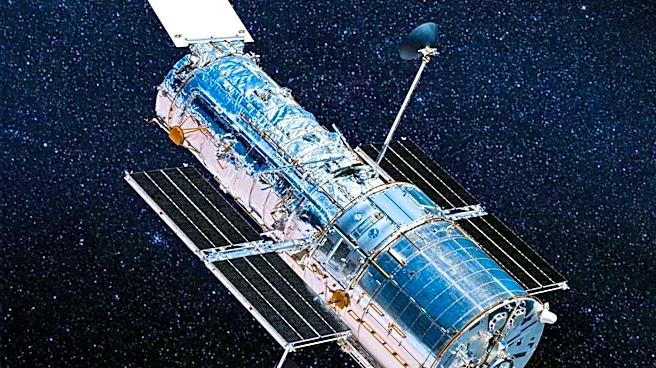
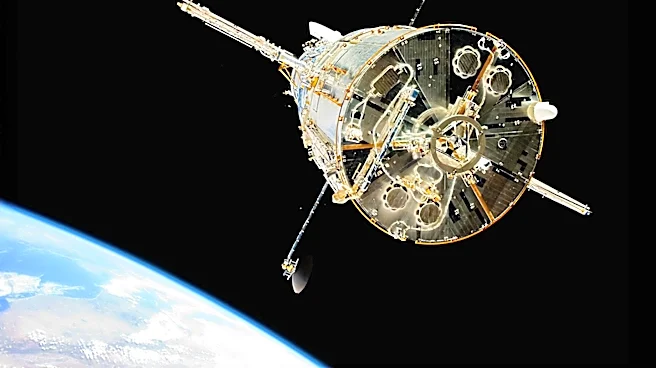
New observations from NASA's Hubble Space Telescope are challenging a prominent theory regarding how the early universe emerged from its cosmic fog. An international research team, including astronomers from the University of Michigan, found that powerful
winds from exploding stars, or supernovae, may actually hinder the escape of ultraviolet radiation from galaxies, rather than facilitating it. This contradicts a widely accepted theory that suggested these winds cleared pathways for radiation, which was crucial for the reionization period approximately 13 billion years ago. During reionization, intense radiation from early galaxies transformed neutral hydrogen into ionized hydrogen, making the universe transparent to ultraviolet light. The study, published in Nature Astronomy, indicates that stronger galactic winds were associated with less escaping ionizing radiation, suggesting that the energy from exploding stars might redistribute gas and dust in ways that block more radiation.
Why It's Important?
This discovery significantly impacts our understanding of cosmic history and the fundamental processes that shaped the universe. Reionization was a critical phase transition that allowed light to travel freely, enabling the universe to evolve into its current state. If the prevailing theory about supernovae's role is incorrect, scientists will need to re-evaluate the mechanisms responsible for this transformation. The findings suggest that radiation from young, massive stars might escape galaxies before these stars explode as supernovae, implying that the earliest stages of star formation could be more crucial than previously thought for reionization. This shift in understanding could lead to better models of how reionization unfolded and how galaxies formed, influencing future research in cosmology and astrophysics.
What's Next?
The research team plans to seek additional observing time with the Hubble Space Telescope to examine more galaxies and confirm if these patterns are consistent across a wider sample. This will help establish the importance of young star activity in allowing ionizing radiation to escape. The findings also have implications for computer simulations of the early universe, which will need to be updated to reflect this new understanding of how radiation and winds from young stars shape their surroundings before supernovae occur. Future studies will likely focus on the earliest stages of star formation and the properties of young, massive stars to better understand their contribution to the reionization process. This ongoing research aims to provide a more complete picture of the universe's last major phase transition.
Beyond the Headlines
This breakthrough highlights the iterative nature of scientific discovery, where long-held theories are continually tested and refined with new evidence. The Hubble Space Telescope, despite its age, continues to provide groundbreaking data that challenges and reshapes our understanding of the cosmos. The implications extend beyond astrophysics, touching upon the very origins of the universe and the conditions necessary for the formation of complex structures. It underscores the importance of international collaboration in scientific research, with nearly 30 scientists from over a dozen institutions contributing to this study. The continuous pursuit of knowledge about the universe's past helps us to better comprehend its present and future, influencing our philosophical and scientific perspectives on existence.