







What's Happening?
Researchers at the China Coast Guard Academy have developed and tested an artificial intelligence (AI) system designed for computer-based military simulations. The primary goal of this AI system is to reduce the risk of using lethal weapons during maritime
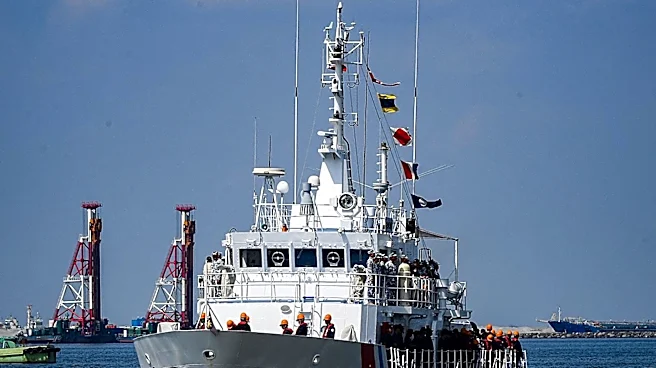
incidents in disputed waters. In numerous simulated scenarios, the AI system successfully prevented any violations of weapons-use rules. For instance, in one simulation involving a Chinese coast guard vessel protecting fishing boats from foreign vessels, the AI maintained a safe distance and adhered to authorization protocols. The AI system also demonstrated superior capability in assessing vessel intentions, correctly identifying them in 89.6% of cases compared to 68.5% with the traditional rule-based system. This advanced system analyzes radar tracks and sensor data, along with a causal model, to evaluate both vessel movement and potential maneuver purposes.
Why It's Important?
The development and testing of this AI system by Chinese researchers have significant implications for international maritime security and the future of military engagement. By reducing the probability of lethal weapons use and rule violations in disputed waters, the AI could potentially de-escalate tensions in sensitive regions. This technology could influence how other nations, including the U.S., approach maritime security and the integration of AI into their defense strategies. The U.S. military and its allies will likely monitor such advancements closely, as they could alter the dynamics of naval operations and international law enforcement at sea. The improved ability of AI to assess intentions and respond non-lethally could lead to new doctrines for engagement, emphasizing precision and de-escalation over traditional force projection, thereby impacting global stability and defense spending priorities.
What's Next?
The researchers plan to further study more complex cross-domain scenarios and human-AI interaction in decision-making, indicating continued development and refinement of the system. This suggests that the AI's capabilities will likely expand to cover a wider range of maritime situations and integrate more deeply with human operators. Other nations, including the U.S., may accelerate their own research and development into similar AI-driven systems for maritime security, potentially leading to an AI arms race in naval technology. The deployment of such systems could also prompt international discussions on ethical guidelines and regulations for autonomous weapons and AI in military applications, especially concerning rules of engagement and accountability in international waters.
Beyond the Headlines
This AI development highlights a deeper trend in military technology: the increasing reliance on artificial intelligence to manage complex and high-stakes situations. The system's ability to prevent rule violations and accurately assess intentions raises ethical questions about the role of AI in decision-making that could lead to conflict. While designed to reduce lethal force, the autonomy of such systems could also introduce new risks, such as unforeseen algorithmic biases or vulnerabilities to cyber-attacks. The integration of AI into coast guard operations also blurs the lines between law enforcement and military action, particularly in disputed territories. This technological shift could fundamentally alter the nature of maritime sovereignty and international relations, pushing for new frameworks for cooperation and conflict resolution in an increasingly automated world.