




What's Happening?
Across the United States, various states are confronting complex issues surrounding the death penalty, encompassing legal challenges, legislative proposals, and scheduled executions. In Texas, Robert Roberson's legal team is seeking a new trial, citing
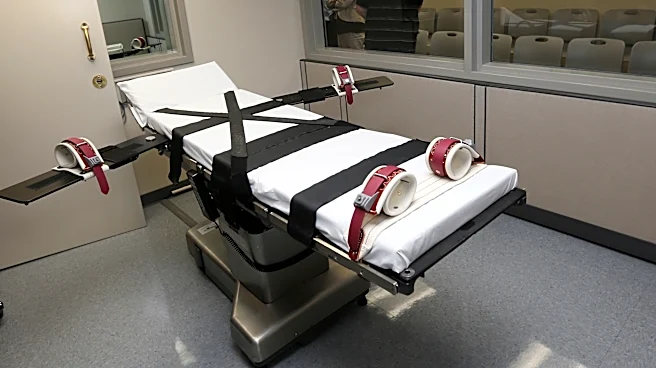
evolving scientific understanding of 'shaken baby syndrome' and referencing a recent Georgia ruling that vacated a similar conviction. Concurrently, Republican Rep. Nancy Mace of South Carolina has introduced legislation to reinstate the death penalty in Washington, D.C., for severe crimes including first-degree murder and acts of terrorism. Virginia has initiated a review of eight past executions linked to a now-discredited state forensic scientist, Mary Jane Burton, raising questions about potential wrongful convictions. North Carolina prosecutors are pursuing the death penalty for three women accused of the torture and murder of a 6-year-old girl. Meanwhile, Florida's Supreme Court denied claims for William Silvia, whose execution is scheduled for August 18. Alabama recently carried out its first execution of the year, Jeremy Williams, for the murder of a 5-year-old, part of a rare day that saw three executions nationwide. A Pew Research Center report indicates that a majority of American adults and Catholics favor the death penalty for murder convictions, despite opposition from Pope Leo XIV.
Why It's Important?
These diverse developments underscore the multifaceted and often contentious nature of capital punishment in the U.S. The Texas case highlights the critical role of scientific advancements in re-evaluating past convictions, potentially leading to exonerations and challenging the finality of death sentences. The legislative push to restore the death penalty in D.C. reflects a broader 'tough on crime' political sentiment, contrasting with national trends towards abolition in some states. Virginia's review is particularly significant as it could provide concrete evidence of innocent individuals being executed, a long-debated point that could profoundly impact the national conversation on capital punishment. The North Carolina case demonstrates the application of the death penalty in instances of extreme violence against vulnerable populations. The recent executions, including a rare triple execution day, suggest a potential acceleration in the pace of capital punishment in some jurisdictions, while the Pew report reveals a persistent public appetite for it, even among religious groups whose leaders oppose it.
What's Next?
The legal proceedings for Robert Roberson in Texas will continue, with a decision pending on whether he will receive an evidentiary hearing. Rep. Nancy Mace's 'Restoring the Death Penalty in DC Act' will proceed through the legislative process in Congress. Virginia's State Crime Commission is expected to submit its findings on the cases linked to Mary Jane Burton, which could lead to further legal actions or policy changes. The three defendants in North Carolina are scheduled to return to court in November. William Silvia's execution in Florida is slated for August 18, and several other executions are scheduled across Florida, Texas, Alabama, and Tennessee through the end of the year. These upcoming events will continue to shape the legal, ethical, and public discourse surrounding the death penalty in the United States, with potential impacts on judicial precedents, legislative reforms, and public opinion.
Beyond the Headlines
The ongoing debates and actions surrounding the death penalty delve into fundamental questions of justice, morality, and the role of the state. Cases like Robert Roberson's challenge the infallibility of the justice system, particularly when convictions rely on evolving scientific understanding, raising ethical concerns about irreversible punishments. The legislative efforts in D.C. and the public support for capital punishment, as indicated by the Pew report, reflect a societal tension between punitive justice and rehabilitative or abolitionist perspectives. Virginia's investigation into potentially wrongful executions confronts the historical injustices within the system, potentially fueling calls for greater scrutiny and reform. These developments collectively highlight the deep divisions and complex considerations that continue to define the death penalty as a legal and moral issue in American society, touching upon themes of human rights, judicial error, and the purpose of punishment.