
What's Happening?
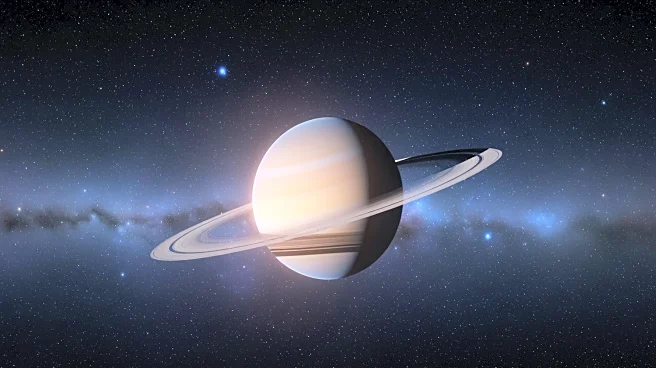
Astronomers have successfully measured the mass of a rogue planet, a celestial body that drifts through space without orbiting a star. This planet, comparable in size to Saturn, was studied using a rare
cosmic alignment that allowed scientists to determine its mass with unprecedented precision. The discovery was made possible through gravitational microlensing, a technique that uses the warping of spacetime by massive objects to magnify the light of a distant star. This event was observed from Earth and the Gaia space telescope, enabling a dual perspective on the planet's gravitational effect. Rogue planets, also known as free-floating planets, are difficult to detect due to their lack of a parent star, which means they emit no detectable light. This breakthrough offers a new method for studying such elusive objects.
Why It's Important?
The ability to measure the mass of a rogue planet marks a significant advancement in exoplanetary science. This discovery opens up new possibilities for studying free-floating planets, which are believed to have formed in star systems before being ejected. Understanding these planets can provide insights into planetary formation and dynamics in the absence of a star. The use of gravitational microlensing as a tool for measuring such planets' mass could lead to further discoveries and a deeper understanding of the universe's hidden celestial bodies. This method bypasses the need for traditional orbital dynamics, offering a new avenue for exploring the cosmos.
What's Next?
The success of this measurement suggests that similar techniques could be applied to other rogue planets, potentially leading to more discoveries. As new telescopes and missions are developed, such as successors to the Gaia observatory, the ability to detect and study these free-floating planets will likely improve. This could significantly enhance our understanding of planetary systems and the processes that lead to the formation and ejection of rogue planets. The continued study of these objects may also contribute to broader astronomical research, including the search for life beyond our solar system.