



What's Happening?
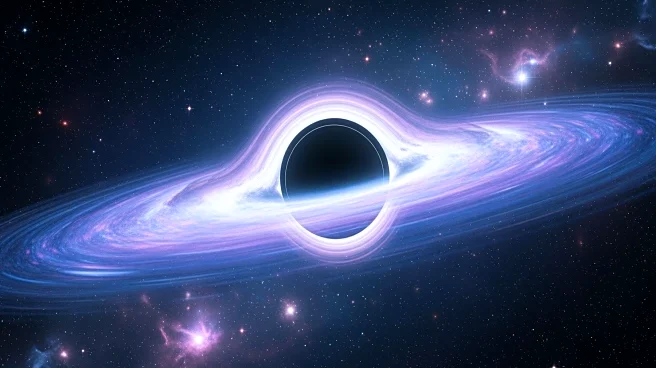
The James Webb Space Telescope has provided new insights into a supermassive black hole located in the Circinus Galaxy, approximately 13 million light-years away. The telescope's enhanced infrared capabilities allowed scientists to determine that most
of the infrared emissions from the black hole originate from a compact, dusty structure feeding the black hole, rather than from outflowing material as previously thought. This discovery challenges earlier theories about the source of infrared light in such environments. The findings, published in Nature Communications, highlight the importance of the Webb telescope in advancing the understanding of black holes and their surrounding structures.
Why It's Important?
This discovery is significant as it reshapes the understanding of how black holes interact with their environments. By identifying the primary source of infrared emissions, scientists can refine models of black hole behavior and their impact on surrounding matter. The research has implications for the study of other black holes, potentially leading to a broader understanding of these enigmatic cosmic phenomena. The Webb telescope's ability to capture high-resolution infrared data opens new avenues for exploring the universe, providing a powerful tool for astronomers to study distant galaxies and their central black holes.
What's Next?
Following this discovery, researchers will likely conduct further studies to explore the implications of these findings on the broader family of active galaxies. The Webb telescope's capabilities will enable scientists to examine other black holes and their environments, potentially uncovering new patterns and behaviors. This research could lead to a deeper understanding of the role black holes play in galaxy formation and evolution. As more data is collected, the scientific community will continue to refine theories and models, enhancing the overall knowledge of black holes and their influence on the cosmos.