



What's Happening?
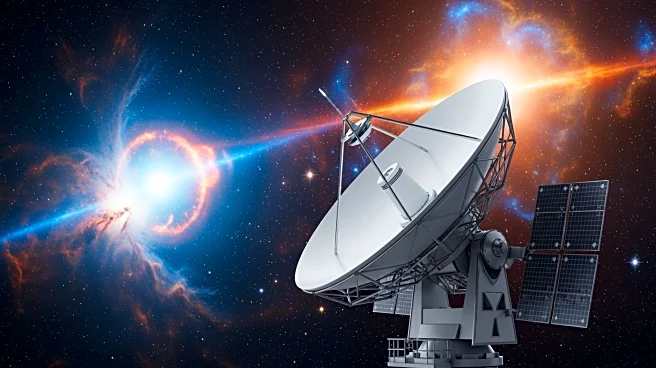
A 10-second gamma-ray burst detected by the SVOM satellite, a joint French-Chinese mission, has been confirmed as originating from a supernova that exploded 13 billion years ago. This event, designated GRB 250314A, was initially detected on March 14,
2025, and later confirmed by the James Webb Space Telescope (JWST). The burst is associated with the death of a massive star and the birth of a black hole, marking it as the most distant supernova ever observed. The detection was further supported by NASA’s Neil Gehrels Swift Observatory and ground-based telescopes, which pinpointed the gamma-ray source and revealed an infrared afterglow. The supernova occurred during the Epoch of Reionisation, a period when the first stars and galaxies began ionizing the intergalactic medium.
Why It's Important?
This discovery challenges existing theories about the early universe, particularly regarding star formation and evolution. The supernova's characteristics closely resemble those of modern supernovae, suggesting that the processes shaping star death and chemical enrichment were already underway just 730 million years after the Big Bang. This finding implies that galaxies may have evolved faster than previously thought, producing multiple generations of stars in a relatively short cosmological timeframe. The event highlights the potential of gamma-ray bursts as tools for probing the universe's earliest epochs, offering insights into cosmic events that occurred billions of years ago.
What's Next?
Researchers plan to use additional observation time on the JWST to monitor similar high-redshift events. These future campaigns will focus on detecting afterglows and host galaxies, aiming to build a clearer picture of early stellar evolution. The continued study of such distant cosmic events could further reshape our understanding of the universe's formative years and the speed at which complexity emerged.