
What's Happening?
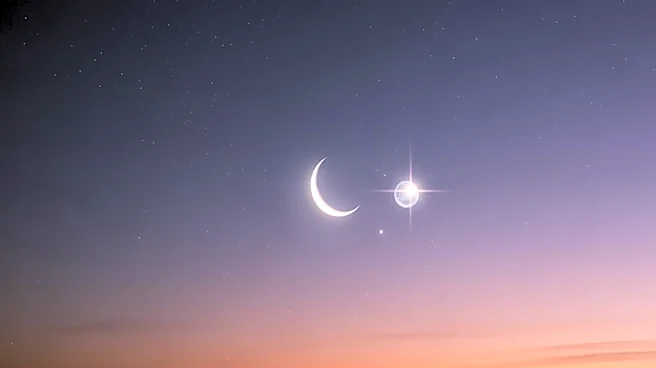
On April 15, a crescent Moon will be visible above the bright planet Mercury in the predawn sky. This celestial event offers a chance to observe both the Moon and Mercury shortly before sunrise. The Moon will rise approximately
an hour before the Sun, with Mercury appearing 40 minutes ahead of sunrise. Observers may also catch a glimpse of Mars nearby, although it will be more challenging to see. The Moon will pass 5° north of Mercury, and the best viewing time is about 30 minutes before sunrise when the Moon is 6° above the horizon. Earthshine may be visible on the Moon's darkened portion, adding to the spectacle.
Why It's Important?
This event provides an opportunity for amateur astronomers and sky enthusiasts to observe a rare alignment of celestial bodies. The visibility of the Moon and Mercury in close proximity allows for educational and observational activities, enhancing public interest in astronomy. Such events can inspire curiosity about the solar system and encourage people to learn more about planetary movements and celestial mechanics. Additionally, observing these phenomena can foster a greater appreciation for the natural world and the universe.
What's Next?
Sky watchers should prepare to view the event by finding a location with a clear view of the eastern horizon, away from light pollution. Binoculars or a telescope can enhance the viewing experience, especially for spotting Mercury and Mars. As the Moon continues its orbit, it will pass near other planets, offering more opportunities for observation in the coming days. Astronomy enthusiasts should stay informed about upcoming celestial events to maximize their stargazing experiences.