










What's Happening?
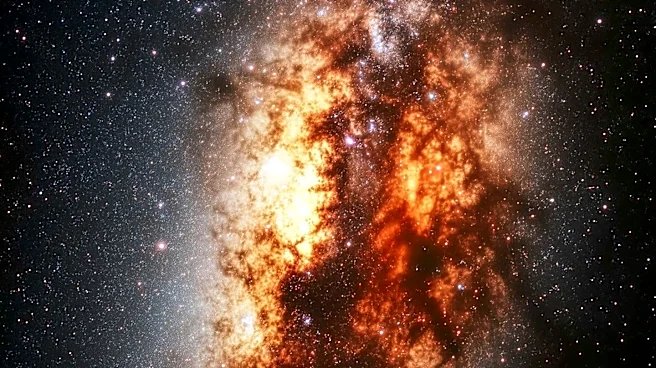
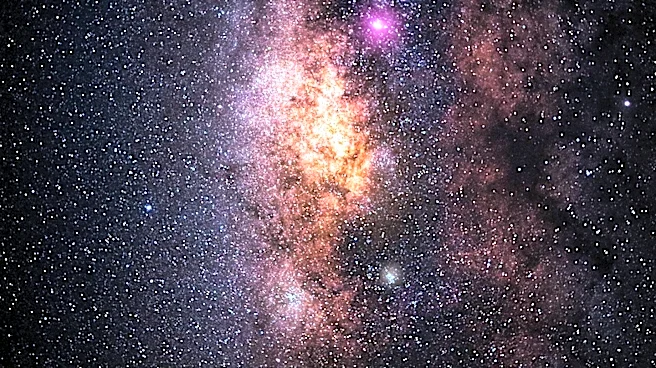
A recent study led by Sofia Feltzing from Lund Observatory has pinpointed the formation of the Milky Way's stellar disk to between 12.1 and 12.5 billion years ago. Using data from over 300,000 subgiant stars, the research team analyzed the kinematics
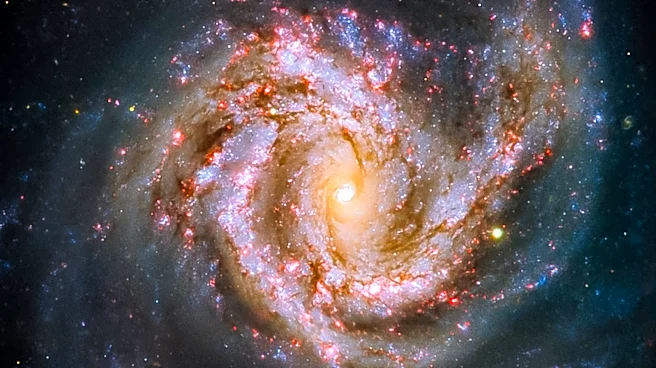
and chemical compositions to determine when the galaxy transitioned from random stellar motions to a rotating disk. This period, known as the 'spin-up,' marks a significant phase in the Milky Way's evolution. The study utilized new stellar databases that provide crucial age measurements, allowing for a more precise timeline of the galaxy's development.
Why It's Important?
Understanding the timeline of the Milky Way's disk formation is vital for comprehending the broader processes of galaxy evolution. The findings suggest a rapid chemical evolution and a shift in kinematic properties, providing insights into how galaxies transition from chaotic structures to organized systems. This research contributes to the field of astrophysics by offering a clearer picture of the early universe's galaxy formation processes. It also sets the stage for future studies to explore lower-metallicity stars, which could further refine our understanding of the Milky Way's history.
What's Next?
Future research will likely focus on analyzing lower-metallicity stars to distinguish between disk and halo stars more accurately. Upcoming large-scale surveys will provide additional data to enhance the precision of these studies. This ongoing research will help astronomers build a more comprehensive model of galaxy formation and evolution, potentially leading to new discoveries about the early universe and the processes that shaped it.