




What's Happening?
Rhode Island's congressional delegation is demanding answers from federal agencies regarding the Trump Administration's alleged political retribution in denying $19 million in disaster aid following a February 2026 blizzard. U.S. Senators Jack Reed and Sheldon
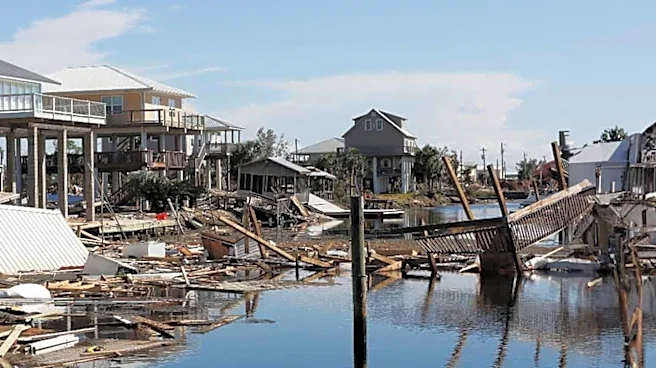
Whitehouse, along with U.S. Representatives Seth Magaziner and Gabe Amo, all Democrats, sent a letter to Homeland Security Secretary Markwayne Mullin and Federal Emergency Management Agency (FEMA) Administrator Cameron Hamilton. The delegation is requesting the preservation of all records and documentation related to Rhode Island's request for a major disaster declaration. They highlight that a joint Preliminary Damage Assessment with FEMA validated over $19 million in damages, which is more than nine times the threshold required for disaster assistance. Despite this, the state's request was denied without a detailed written explanation. The lawmakers cited a Politico report suggesting that President Trump overrode his own agencies to deny disaster requests from four Democratic states, including Rhode Island.
Why It's Important?
This situation raises significant concerns about the politicization of federal disaster relief and the potential for executive power to be used for partisan purposes. Federal disaster aid is intended to provide critical support to states and communities recovering from natural disasters, regardless of their political affiliation. The alleged denial of aid to Rhode Island, despite exceeding FEMA's damage thresholds, could set a dangerous precedent where disaster relief becomes a tool for political leverage rather than a humanitarian response. This could undermine public trust in federal institutions and their ability to provide impartial assistance during crises. For Rhode Island, the denial of $19 million in aid means that the state and its residents must bear the full financial burden of recovery from a severe blizzard that caused widespread power outages, two fatalities, and hundreds of emergency room visits. This financial strain could impact state and local budgets, potentially diverting funds from other essential services and slowing down recovery efforts. The incident also highlights the importance of transparency and accountability in federal decision-making processes, especially when it involves critical aid to states.
What's Next?
The Rhode Island congressional delegation expects a response from Homeland Security Secretary Markwayne Mullin and FEMA Administrator Cameron Hamilton regarding their request for the preservation and provision of all relevant communications and records. Their letter implies that a failure to provide this information would suggest the claims of political retribution are valid. Depending on the response, the delegation may pursue further actions, such as congressional investigations or public hearings, to uncover the full extent of the decision-making process. The outcome could influence future policies regarding federal disaster aid distribution and potentially lead to reforms aimed at preventing the politicization of such assistance. This incident may also become a point of contention in future political discourse, particularly concerning the role of the executive branch in federal aid decisions and the balance of power between federal and state governments during disaster recovery.
Beyond the Headlines
The alleged denial of disaster aid to Rhode Island transcends a simple administrative decision; it touches upon fundamental principles of federalism and the impartial application of government resources. The claim that President Trump overrode agency recommendations for political reasons suggests a potential erosion of the non-partisan nature of federal agencies like FEMA, which are designed to operate based on objective criteria. This could lead to a chilling effect where states, particularly those with opposing political leadership, might hesitate to fully trust federal assistance in times of crisis. The incident also highlights the vulnerability of states to the discretionary power of the presidency, even when established protocols and damage assessments indicate a clear need for aid. Ethically, it raises questions about the moral obligation of the federal government to assist all citizens equally during emergencies, irrespective of political leanings. Legally, it could prompt discussions about the checks and balances necessary to prevent the abuse of executive authority in critical areas like disaster relief, potentially leading to calls for more codified and less discretionary processes for aid allocation.