


What's Happening?
The Hibakusha Federation, an organization representing atomic bomb survivors, is grappling with the challenge of continuation as the average age of its members surpasses 85. With the number of survivors dwindling, discussions are underway to redefine
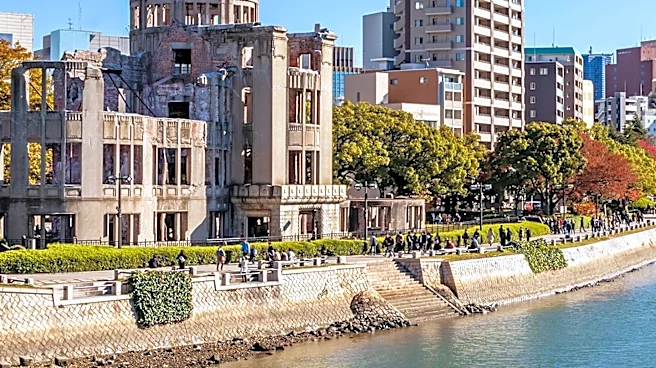
the organization's structure and ensure the preservation of memories for future generations. Concurrently, the Hiroshima Peace Memorial Museum has opened a new 'Origami Crane Experience Space' to engage visitors, particularly a growing international audience, in a more interactive way. This space allows visitors to fold origami cranes, which are then dedicated to the Children's Peace Monument in the Peace Memorial Park, transforming individual actions into a shared act of remembrance. Furthermore, Hiroaki Mito, a 'hibakusha from in utero exposure' who has dedicated over 20 years to conveying the horrors of nuclear weapons, received the Tanimoto Kiyoshi Peace Prize, recognizing his sustained efforts in memory inheritance despite not having direct memories of the bombing. These developments highlight a multi-layered approach to ensuring the legacy of the atomic bomb survivors continues.
Why It's Important?
The efforts in Hiroshima are crucial for the global discourse on nuclear disarmament and peace, particularly as the direct witnesses to the atomic bombings diminish. The Hibakusha Federation's struggle for continuation underscores the urgent need for institutionalized memory inheritance, moving beyond reliance on individual testimonies. This shift is vital for maintaining the historical record and preventing the normalization of nuclear weapons. The Origami Crane Experience Space at the Hiroshima Peace Memorial Museum is significant because it offers a tangible, participatory way for a diverse international audience to connect with the message of peace. This hands-on engagement can foster empathy and understanding, making the abstract concept of nuclear war more personal and impactful. Hiroaki Mito's recognition demonstrates that memory inheritance can extend beyond direct experience, providing a model for how future generations can continue to advocate for peace by learning and conveying historical facts. These initiatives collectively aim to ensure that the lessons of Hiroshima remain relevant and compelling, influencing future policy decisions and public opinion on nuclear weapons worldwide.
What's Next?
The Hibakusha Federation will continue discussions on redefining its structure, with a focus on integrating second and third-generation hibakusha and exploring collaborations with local educational institutions. The Hiroshima Prefectural Hibakusha Federation is considering developing lesson programs utilizing video archives of hibakusha testimonies for elementary and junior high schools. The Origami Crane Experience Space is expected to further enhance visitor engagement at the Hiroshima Peace Memorial Museum, particularly with its growing international demographic. There is potential for these initiatives to connect, such as integrating the Hibakusha Federation's testimony archives into the museum's experience programs. The model of 'narrators without experiences' like Hiroaki Mito could be cultivated and expanded, potentially overlapping with the activities of the Hibakusha Federation's younger generations. The ongoing challenge will be to ensure that these individual points of effort evolve into a cohesive and sustainable system for memory inheritance, preventing the fading of critical historical memory.
Beyond the Headlines
The initiatives in Hiroshima delve into the profound ethical and cultural dimensions of memory inheritance, particularly in the context of traumatic historical events. The transition from individual testimony to institutionalized and participatory forms of remembrance raises questions about authenticity and the evolving nature of historical narratives. The Origami Crane Experience Space, by transforming visitors from 'onlookers' to 'doers,' highlights the power of embodied experience in fostering empathy and understanding across cultural and linguistic barriers. This approach acknowledges that direct experience is not the sole pathway to meaningful engagement with history. Hiroaki Mito's work, 'speaking without memories,' challenges conventional notions of witness and underscores the importance of secondary and tertiary forms of testimony. These efforts collectively represent a conscious societal attempt to create a 'system of inheritance' that can withstand the passage of time and the loss of direct witnesses, ensuring that the moral imperative against nuclear weapons remains a living legacy. This shift reflects a broader societal recognition that memory is not merely preserved but actively constructed and transmitted through various forms of engagement.