






What's Happening?
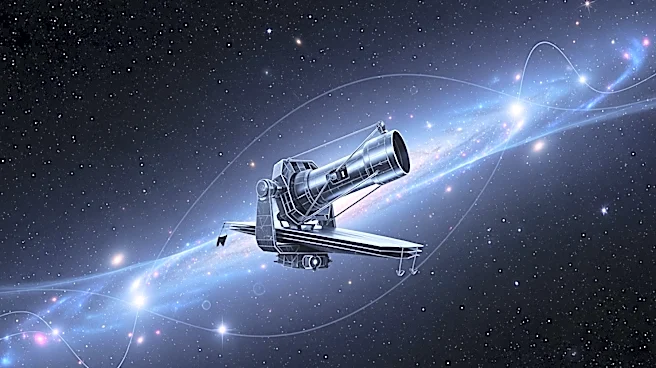
NASA's Jet Propulsion Laboratory (JPL) engineers have shut down the Low-energy Charged Particles experiment (LECP) on Voyager 1 to conserve power and extend the spacecraft's operational life. Launched in 1977, Voyager 1 has been providing critical data
on the interstellar medium, including measurements of ions, electrons, and cosmic rays. The decision to turn off the LECP was part of a pre-planned strategy to gradually shut down instruments as the spacecraft's power diminishes. This move follows the shutdown of the same instrument on Voyager 2 in March 2025. The LECP has been instrumental in detecting pressure fronts and varying particle densities beyond the heliosphere, contributing to our understanding of space beyond our solar system.
Why It's Important?
The shutdown of the LECP on Voyager 1 marks a significant step in managing the spacecraft's dwindling power resources, ensuring it continues to provide valuable scientific data. Voyager 1, along with its twin Voyager 2, remains the only spacecraft capable of delivering information from such distant regions of space. The data collected by Voyager 1 has been crucial for understanding the interstellar medium, impacting scientific research and theories about space beyond our solar system. As power resources become scarce, strategic decisions like this are essential to prolong the mission's life, allowing continued exploration and discovery in areas previously unreachable.
What's Next?
As Voyager 1 continues its journey, NASA will likely face further decisions regarding which instruments to shut down next. The spacecraft's ability to transmit data will depend on careful management of its remaining power. Future steps may involve prioritizing instruments that provide the most critical data, ensuring the mission's scientific goals are met for as long as possible. The ongoing operation of Voyager 1 will continue to be a testament to human ingenuity and the quest for knowledge about the universe.